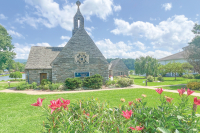
Trail association celebrates legislative victory
H.R. 2768 Benton MacKaye National Scenic Trail Feasibility Study Act of 2025, as amended, has passed out of the House Committee on Natural Resources. The amendment requires the feasibility study to be completed within two years. (The Senate version required a one-year study.)
Word from the Smokies: Park entomologist reflects on career of conserving insects
From bears and bobcats to eagles and elk, 22,893 species have been documented so far in Great Smoky Mountains National Park — and nearly half of them are insects. Becky Nichols, the park’s long-time entomologist, has dedicated her career to learning about and protecting lifeforms like bees, wasps, moths and butterflies.
As a child in rural Washington state, Nichols gravitated toward nature and animals of all sorts. She knew from a young age that she wanted a career related to the environment.
Over 1,000 acres protected in Haywood County
The Southern Appalachian Highlands Conservancy has transferred 1,060 acres in Haywood County to the State of North Carolina to become part of public lands managed by the NC Wildlife Resources Commission.
These tracts include land for the Cold Mountain Game Land and Pisgah Game Lands, including the 409-acre White Oak Mountain tract adjoining the Great Smoky Mountains National Park that SAHC purchased in December 2024.
Headwaters plan sets conservation roadmap for Jackson County
Jackson County commissioners have approved a sweeping new conservation framework designed to balance growth with preservation across some of the most ecologically significant lands in Western North Carolina, located in the southern part of the county.
94 acres conserved in Panthertown Valley
Thanks to a collaboration among local conservation partners, Mainspring Conservation Trust has acquired a critical 94-acre inholding within Panthertown Valley that is now on track to be permanently protected.
One of Western North Carolina’s most cherished natural areas, Panthertown is often called the “Yosemite of the East.”
Roadless Rule recission appears to undermine public opinion
The National Forest Service, housed under the United States Department of Agriculture, plans to rescind the 2001 Roadless Rule instated by President Bill Clinton to protect national forests’ roadless acres.
Drawing opposition from 99% of public commenters, this recission is part of a series of opaque federal actions and policies instituted in the face of significant public outcry.
48 acres preserved by land trust
The Highlands-Cashiers Land Trust is proud to announce the permanent protection of 47.97 acres of ecologically significant land generously donated by High Hampton. This private conservation easement ensures the preservation of unique natural features such as rock outcrops, mature forests, headwaters, floodplains and mountain bogs.
Hyatt named executive director of regional land trust
Mainspring Conservation Trust has named Sylva resident Jeremy Hyatt as its new Executive Director.
Hyatt, a Tribal citizen of the Eastern Band of Cherokee Indians, brings more than 15 years of leadership experience in government, natural resources and cultural preservation.
The Sorrowful Botanist: Dr. J Dan Pittillo (1938-2025)
On Monday, Aug. 11, J. Dan Pittillo died. The world has lost an amazing person, a gifted and kind educator, a dedicated father and husband, and one of the top botanists in the Southern Appalachian Mountains and the Southeastern United States.
Highlands protects 32 acres
Highlands-Cashiers Land Trust announced the conservation of 31.69 acres of ecologically valuable land within the town limits of Highlands. Located off Bowery Road, the property overlooks Horse Cove Valley.