More strands for the tapestry
“Attention must be paid.”
Linda Loman, wife of Willy Loman, delivers that well-known line in Arthur Miller’s play “Death of a Salesman.” Willy is crash-diving into catastrophe, suffering from exhaustion, failure and delusions, and Linda wants her sons to step up and pity and support their father: “He put his whole life into you and you’ve turned your back on him.” she tells them, “So attention must be paid. He’s not to be allowed to fall in his grave like an old dog. Attention, attention must finally be paid to such a person.”
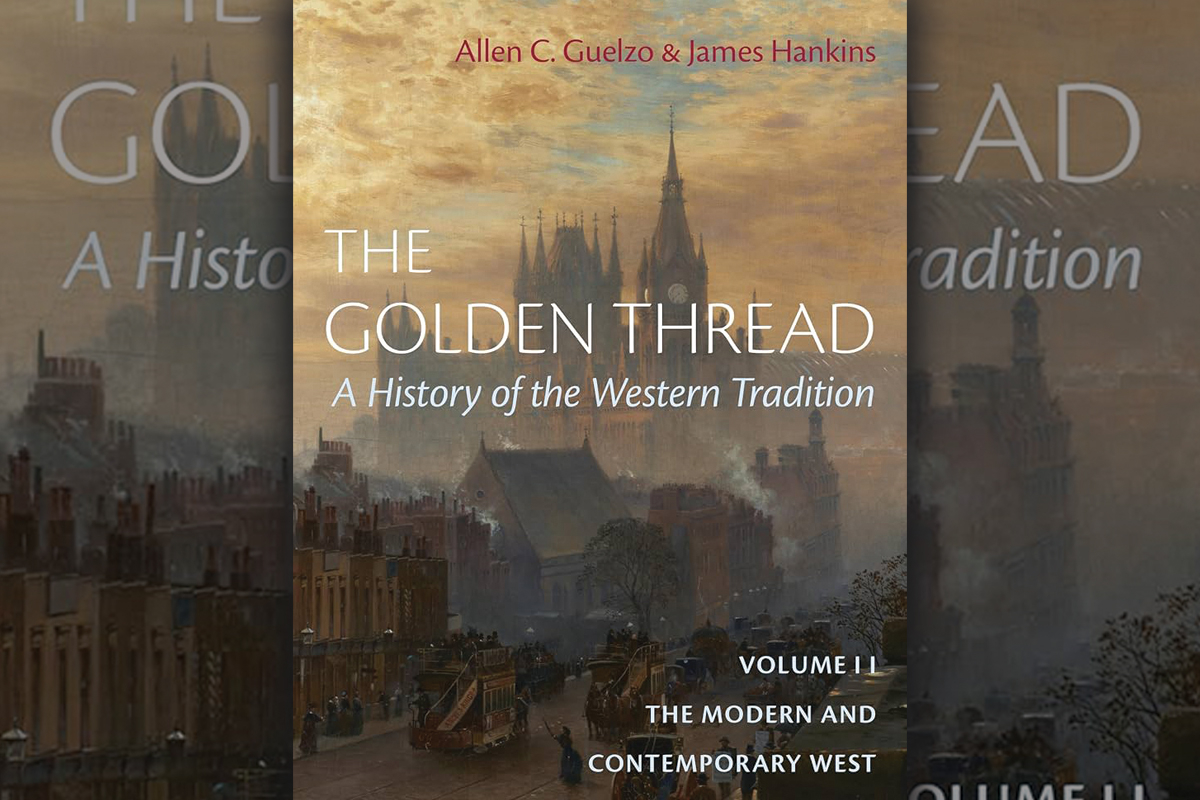
Odd as it may be, Linda Loman’s speech popped to mind recently on reading the introduction to “The Golden Thread: Volume II: A History of the Western Tradition: The Modern and Contemporary West” (Encounter Books, 2026). Here Princeton University’s Allen Guelzo and retired Harvard professor James Hankins write, “In recent decades, the Western past has been widely condemned and even held in contempt, and surprisingly from a position of near-total ignorance. Voices from outside and inside the Western tradition have condemned Westerners as oppressors, imperialists, colonizers and appropriators.”
Guelzo and Hankins are not averse to such views — self-criticism, they agree, is a hallmark of Western civilization — but do take to task those critics who launch such attacks “in the attitude of novelty, performance even self-adulation than out of serious argument.” But their real answer to these detractors of Western civilization are the two volumes of “The Golden Thread,” the history on which they collaborated.
Back in the fall, I reviewed Volume I of “Golden Thread” for The Smoky Mountain News. Written by Hankins, that 1,200-page book serves both as an excellent to Western history up through the Renaissance and as a portable art museum. Now Guelzo completes this dynamic story with his 900-word history from the Reformation to the end of the 20th century.
Like its companion, Volume II is filled with all sorts of ancillary marvels, paintings and photographs, excerpts from writers and thinkers, maps and lists. The narrative prose is crystal clear, a professor in print opening up the past to students and to anyone else with an interest in the story of Western civilization.
Related Items

‘Cherokee People and the American Revolution’

Upcoming events at City Lights

The 7th Crusade—US Folly in Iran

Remember the Removal: A 950-mile bike ride, and so much more
In the last few pages before its invaluable Appendix, Guelzo’s “Gold Thread” concludes with the juxtaposition of Francis Fukuyama’s “end of history” theory and Samuel Huntington’s “clash of civilizations.” With the downfall of the Berlin Wall in 1989 followed by the collapse of the Soviet Union, Fukuyama had posited that the termination of the Cold War had resulted in “the universalization of Western liberal democracy as the final form of human government.”
Huntington countered Fukuyama’s thesis with the argument that civilizations aren’t based as much on political and economic systems as they are on culture. A country like Saudi Arabia, for instance, can readily and willingly adapt Western technology and banking, but remain a cultural entity distinct from France or Canada.
Guelzo then points readers to the differences between Western and Middle Eastern cultures. In a few pages, he covers the cultural and sometimes martial conflicts between Western nations, like the United States and Israel, and Arab countries. He then ends “The Golden Thread” with a look at Ramzi Yousef, the militant Islamist involved in the 1993 plot to bring down the Twin Towers with a bomb. Guelzo writes, “At his trial in 1997, he saw nothing unjustified in using mass murder to strike terror into Western hearts.” Guelzo then supplies this statement made by Yousef at that trial:
“Yes, I am a terrorist and I am proud of it. And I support terrorism as long as it was against the United States government and against Israel, because you are more than terrorists; you are the one who invented terrorism and using it every day.”
Guelzo then ends his study of history with this comment: “This did not sound like the end of history. And the next quarter century would demonstrate all too well how great the challenges to Western civilization would remain.” The next two pages feature a 1980 nighttime shot of the New York City skyline and the Twin Towers.
Given the ongoing clash of cultures in the world, we must remain awake to attacks on the West and its culture.
Attention must be paid.
(Jeff Minick reviews books and has written four of his own: two novels, “Amanda Bell” and “Dust On Their Wings,” and two works of nonfiction, “Learning As I Go” and “Movies Make the Man.” This email address is being protected from spambots. You need JavaScript enabled to view it..)