Inductees into the WNC Agricultural Hall of Fame celebrated
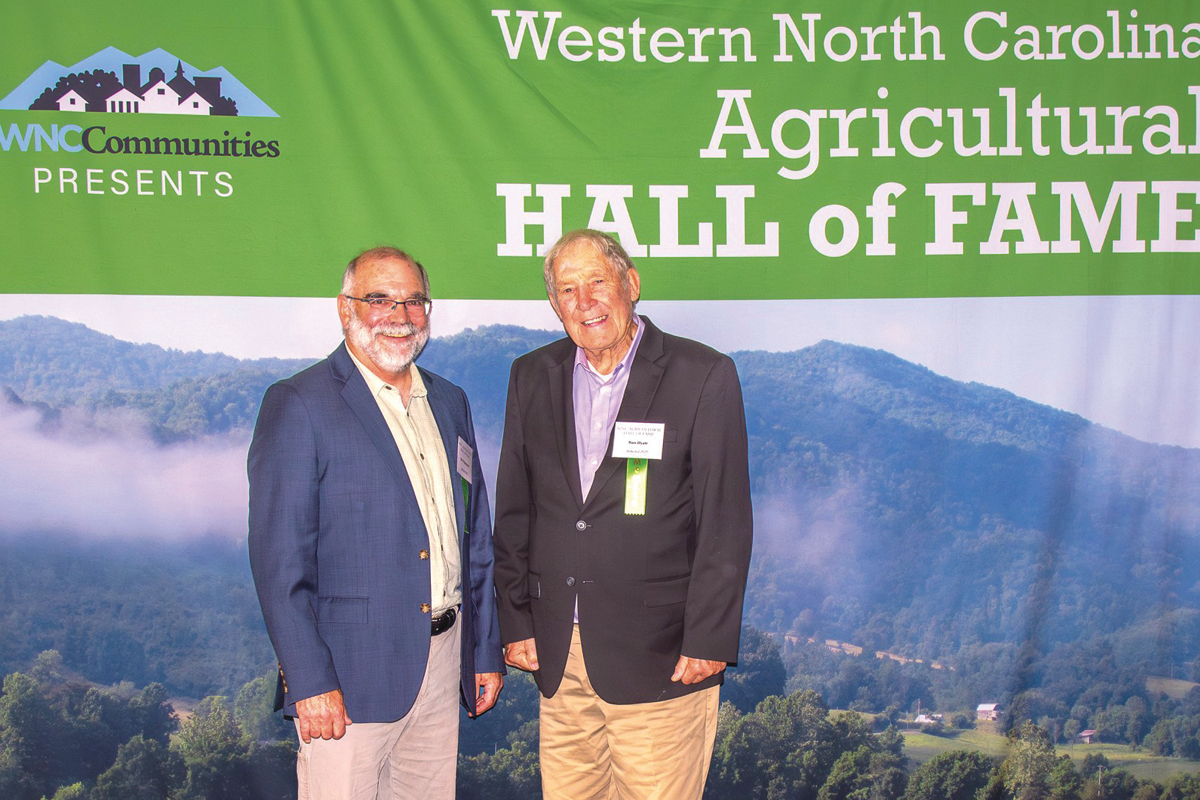 Jim Walgenbach (left) and Bass Hyatt (right) were inducted into the WNC Agricultural Hall of Fame on Aug. 8, 2025.
Donated photo
Jim Walgenbach (left) and Bass Hyatt (right) were inducted into the WNC Agricultural Hall of Fame on Aug. 8, 2025.
Donated photo
WNC Communities announced the induction of the 2025 honorees into the prestigious Western North Carolina Agricultural Hall of Fame. This honor recognizes individuals who have shown unwavering dedication, visionary leadership and outstanding contributions to the agribusiness sector of the region.
The induction ceremony took place Aug. 8 at the WNC Agricultural Center’s Davis Event Center, bringing together community members, industry leaders and families to celebrate the achievements of the 2025 inductees. This annual event serves as a reminder of the crucial role agriculture plays in the economic and cultural fabric of our region.
2025 Inductees:
Bass Hyatt is a lifelong farmer at Seven Meadows, a family-owned farm since 1865. Hyatt is renowned for his commitment to sustainable farming practices. He began working with NC State University’s Amazing Grazing program 25 years ago, contributing invaluable research that has benefitted beef cattle farmers throughout Western North Carolina. Hyatt’s use of Adaptive Grazing Management, a method that improves soil health, increases rainfall infiltration and enhances forage growth, allows him to graze animals year-round, eliminating the need for supplemental hay.
Having retired from the Farm Service Agency in 1997, Mr. Hyatt embraced full-time farming, blending his knowledge of federal and state programs through agencies such as NRCS and Soil and Water Conservation to improve mountain farming practices. He is a champion of collaboration, often hosting field days to share his insights with fellow farmers. His dedication to innovation and sustainable agriculture continues to highlight the vital connection between conservation and farming.
Since 1986, Jim Walgenbach has served as a research and extension entomologist at the Mountain Horticultural Research & Extension Center, leading groundbreaking studies in the area of integrated pest management on fruit and vegetable crops. This has included development of insect phenology models to optimize pesticide applications and non-insecticide strategies such as pheromone-mediated mating disruption that has empowered farmers in Western North Carolina to more effectively manage pest populations, reducing crop damage and saving money. Walgenbach has advised many graduate students, postdoctoral scholars and international researchers, who have adapted his research for use in their own countries.
Part of Dr. Walgenbach’s research has focused on the Brown Marmorated Stink Bug, a pest that was first detected in North Carolina in 2009. Through his work, he has helped develop integrated pest management programs to control this invasive species. His contributions have been particularly valuable to apple and tomato growers, who benefit from his expertise and solutions. Walgenbach’s compassionate and collaborative approach has made him a trusted resource for farmers both locally and internationally.