Damage is done: Macon to make changes following damage caused by debris removal
Over the last few months, Maconians have sounded the alarm on what they see as excessive debris removal in the county’s waterways. Now, as the cleanup effort wraps up, citizens are maintaining pressure, urging elected officials to learn from the debacle and institute safeguards for the future.
The Joyful Botanist: Let this umbrella make you smile
Were you suddenly stuck on a north facing hillside in the Blue Ridge mountains during a Summer thunderstorm and were without jacket or hood, in theory you could pull off the leaf of one of my favorite wildflowers, flip it upside down and wear it on your head like one of those cheesy umbrella hats — that is, if you are near to where the umbrella leaf grows.
Rose show returns to NC Arboretum
The Asheville-Blue Ridge Rose Society will host its annual Rose Exhibition at The North Carolina Arboretum in the Education Center from 9 a.m. to 5 p.m. May 24 and 25.
This two-day event showcases the diverse range of roses grown by Rose Society members and at local gardens.
Haywood Master Gardeners host plant clinic
Do you have a gardening question? NC State Extension Master Gardener volunteers are available to answer your questions about lawns, vegetables, flowers, trees and ornamental plants; disease, insect, weed or wildlife problems; soils (including soil test results) and fertilizers; freeze and frost damage; and cultural and chemical solutions to pest problems.
Master gardeners to answer questions at Haywood farmers market
Master gardener volunteers will be on hand at a booth on the second and fourth Saturdays of each month, May through August, at Haywood’s Historic Farmers Market in Waynesville in the HART Theater parking lot.
Lake Junaluska plant sale offers new varieties
Lake Junaluska’s Spring Plant Sale will be 8 a.m. to 1 p.m. Saturday, May 3, at the Nanci Weldon Memorial Gym.
For sale will be a few thousand plants, including an assortment of annuals, perennials, herbs and vegetables, hanging baskets and several varieties of native plants from the Corneille Bryan Native Garden, said Melissa Marshall, Lake Junaluska director of grounds.
Much of Western North Carolina still abnormally dry
The North Carolina Drought Management Advisory Council has classified most of the state as at least abnormally dry with only a few counties entirely normal. Over half of the state’s counties are abnormally while 42 counties — all east of The Smoky Mountain News coverage area — are in a moderate drought. Onslow County is in a severe drought.
The Joyful Botanist: Robin’s Plantain
Among the earliest flowering members of the Aster Family (Asteraceae) is the robin’s plantain (Erigeron pulchellus). Around Cullowhee, the robin’s plantain begins blooming in early April at lower elevations and can be seen blooming at higher elevations into June.
The Joyful Botanist: Up Moses Creek
I really enjoy and am honored by the fact that I share this column space with Burt Kornegay who writes the fun and informative column. I like sharing this space because I enjoy reading his writing, and because he is a friend and a big influence on me and my work leading plant walks.
Invasive plant crew celebrates milestone
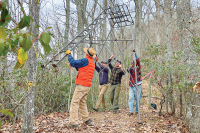
The Pisgah Conservancy’s Invasive Plant Management Crew celebrates one year of tackling non-native invasive species in the forest this month.
The Invasive Plant Management Crew is the first and only of its kind fully dedicated to working in the Pisgah Ranger District.