Botany, beauty and Bartram: The flower hunter's legacy
More than two centuries after William Bartram explored the Southern Appalachian foothills, his words, like his footsteps, still echo through the ridgelines and river valleys he once traversed.
The Joyful Botanist: Let this umbrella make you smile
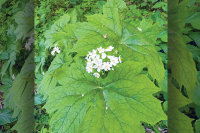
Were you suddenly stuck on a north facing hillside in the Blue Ridge mountains during a Summer thunderstorm and were without jacket or hood, in theory you could pull off the leaf of one of my favorite wildflowers, flip it upside down and wear it on your head like one of those cheesy umbrella hats — that is, if you are near to where the umbrella leaf grows.
The Joyful Botanist: Robin’s Plantain
Among the earliest flowering members of the Aster Family (Asteraceae) is the robin’s plantain (Erigeron pulchellus). Around Cullowhee, the robin’s plantain begins blooming in early April at lower elevations and can be seen blooming at higher elevations into June.
The Joyful Botanist: Something Spicy
Many of the first signs of springtime are subtle. There are little shifts in the breeze as the sun begins to feel a bit warmer and remains in the sky a little bit longer each day. Birdsong increases morning and evening, and other flying beings begin buzzing around looking to forage some pollen and nectar.
The Joyful Botanist: Viola Blues
When seeking beautiful native wildflowers, I often travel and hike long distances to a special spot to see a rare beauty. Other times, it’s as easy as walking into the front yard.
The Joyful Botanist: Back into the briar patch
I got stuck thinking about plants in the genus Smilax after writing about them last time out. It is such a great genus of plants, and as I discussed in my last column, most people only see them as a nuisance. I think they might be one rank below yellow jackets (Vespula spp.) and poison ivy (Toxicodendron radicans) as the most despised organisms in the woods.
The Joyful Botanist: A cedar by any other name
When is a cedar not really a cedar? Well, in the case of the evergreen tree that most people know as eastern red-cedar (Juniperus virginiana), that answer is always. This cedar is not truly a cedar. Its common, or folk name is red-cedar, which I’ve also seen written as red cedar. And often people will shorten that to cedar and would assume that it is truly a cedar.
The Joyful Botanist: Happy Holly Days
Editor’s note: This is a re-print of a column that originally ran in 2022.
There are many different plants that Appalachian mountainfolk have used for centuries in their decorations and celebrations on or around the winter solstice.
The Joyful Botanist: Fall Wildflower Color
When it comes to fall leaf color, trees are what comes to mind for most. Sure, trees are big and there are lots of them. In Autumn when the leaves change they attract a lot of attention and draw tens of thousands of visitors. Most articles and reports about fall color are referencing trees, and possibly some shrubs. I’d like to show some love for the beautiful changing colors of herbaceous plants on the forest floor.
The Joyful Botanist: Turtleheads
There are many different wildflowers that signal the seasonal transition from summer into fall.
I used to be overcome with the melancholy of fall when I would see the goldenrods (Solidago spp.) start to bloom, thinking “No, it’s too early for the end of the blooming season and the start of winter!” That’s how I used to think of fall. Goldenrods no longer usher in the sadness for me as I have successfully reframed them as a summer wildflower that blooms into fall.