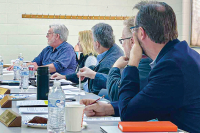
Where do schools rank? With not enough money to go around, commissioners may have to choose between employee raises and schools
Schools got only a brief and passing mention by Haywood County commissioners during a brainstorming session last week on priorities for the coming year.
Education came up near the end of a free-wheeling 90-minute discussion, with only two to three minutes spent on the topic.
County commissioners later said that education is top priority, however, and its short and late mention in their discussion is no indication of the importance they ascribe to it.
“With this board, schools have been at the top,” said Commissioner Bill Upton, former superintendent of the school system who was a career educator.
Commissioners said their commitment to the schools goes without saying — literally — thus they really didn’t need to say very much about it.
“That’s a matter that we know every year is at the top of our to-do list. It is just always a priority,” said Commissioner Mark Swanger. “It is just a given.”
Of the five commissioners, three have been leaders in the school system. Upton as superintendent, principal and teacher; Swanger as school board chairman; and Sorrells as a former school board member.
Sorrells agreed that schools are “a given.”
SEE ALSO: Lottery money hardly a win for schools
“Boom — that is part of the budget,” said Sorrells. “Historically, Haywood County has always, always supported education, and I feel like our board is still very much in tune to that.”
Sorrells was the one who brought up education in the 11th hour of the priority-setting budget discussion. He realized education hadn’t been mentioned yet and didn’t want the meeting to slip by without at least some acknowledgement that schools would be attended to.
“Albeit it come up at the end, but it come up,” Sorrells said.
The school system has been saddled with funding cuts at both the state and county level. Haywood County Schools has lost 129 positions and $8 million compared to its pre-recession days.
Meanwhile, commissioners have pledged not to raise taxes, so the prospect of more school funding could be slim, even though commissioners said philosophically they wish they could restore cuts to the school’s budget.
“But how in this economy when people are struggling do you come up with that extra money?” Sorrells asked. “I am torn between that. It is a Catch 22 for me.”
Chuck Francis, chairman of the Haywood County school board, said he empathizes with commissioners who are still handcuffed by the economic realities of the time. However, Francis hopes lost funding can be restored, as cuts are starting to take their toll.
“We’ve got a great school system here, and we need to protect it,” said Francis. “It is a selling point for the county. If we lose a good school system, people don’t want to move here. They won’t want to work here.”
Top of the list?
With Haywood commissioners pledging not to raise property taxes, it leaves little wiggle room in next year’s budget. No new money coming in means no new money to go around.
There may be a little extra money — little being the operative word — if an uptick in spending stays on track to bring in more sales tax this year compared to last. A modest number of new houses and businesses being added to county tax rolls will also bring in a little more property tax.
The debate will likely come down to who — or what — will get first dibs on that little bit of extra money.
“I don’t know yet. I think we are still a little bit early,” Swanger said.
The majority of commissioners have indicated cost-of-living raises for county employees may top the list if there is any money to go around.
“One thing we will look at is county employees — the 501 county employees who haven’t gotten a raise,” Upton said.
County employees have not gotten an across-the-board cost of living increase in five years.
“Our employees have sacrificed a lot, being asked to do more with less and getting paid less as gas and other things are going up. I would like to see us help our employees some if at all possible,” Swanger said during budget discussions last week.
The county has awarded merit raises to particularly deserving employees, those who have taken on additional responsibilities or proven particularly exceptional.
“They realize we do have some real high performers and people are doing more,” County Manager Marty Stamey said.
Teachers would probably like to see pay raises too, but haven’t seen one in four years.
“Of course, the teachers’ pay scale from the state has been frozen,” Francis said.
In Haywood County, school teachers get a local bonus — 4.5 percent of the base salary from the state. These supplements are supposed to attract better teachers. While higher than many counties its size, Haywood’s teacher salary supplement is still lower than most of the state’s more urban counties — and lower than Buncombe and Asheville.
Haywood County commissioners and the school board pledged to work together to increase the local bonus a little each year until Haywood County caught up. That plan was sidelined with the recession, however.
Morally, it would be difficult to lay off even more people to afford raises for everyone else, Assistant Superintendent Bill Nolte said.
“As far as I am concerned, how in the world can we increase the supplement when we have lost 129 employees,” said Nolte, citing the toll on the workforce in Haywood’s school system since 2008.
The county likewise has laid-off staff — more than 50 positions have been cut in four years.
Commissioner Kirk Kirkpatrick said giving employees raises is an admirable goal, but he pointed out that in this economy, jobs are hard to come by, and there are always plenty of applicants for any open position the county has had.
Still, with the majority of commissioners reflecting a desire to give employees raises with the little bit of extra money in its coffers, the best-case scenario for the schools may simply be no more cuts.
“We all want to keep it at least where it is,” Upton said. “I am thinking our mindset is we just want to maintain. Maintain — that is the big thing from our budget session.”
Sorrells agreed the schools, like everyone in county government, will likely be hearing the “do more with less” refrain again this year.
“That has been our theme in the county, and we are going to be in that mode for a little while,” Sorrells said.
In the meantime, commissioners are pinning their hopes on consumer spending to increase sales tax revenues. The more it goes up, the more additional money they have to spread around.
A cut of the state sales tax flows back to counties. In the last quarter of 2011, Haywood County saw a slight uptick compared to the same quarter of 2010 — an extra $65,000. It’s hardly enough to pay for raises for all 501 county employees and still have some left over for the schools.
But, Stamey hopes the trend will continue through the next six months.
“The key is sales tax,” Stamey said. “That is the key one we are monitoring closely.”
Common ground
Schools get most of their budget from the state, which pays the lion’s share of teacher salaries. Counties foot the bill to construct and maintain school buildings. That’s the simple version anyway.
Counties also contribute to varying degrees for additional positions, from teachers to extra teacher’s assistants to school secretaries to janitors. Counties also pay for incidentals like activity buses used for field trips.
Haywood County chips in a larger contribution per pupil than many counties its size, and that commitment hasn’t changed, Commissioner Mark Swanger said, despite the belated shout out schools got in the budget priority discussion.
“All you can say is you want to fund education,” Swanger said. “We didn’t get into dollars on anything because we just aren’t there yet.”
Plus, the county isn’t entirely sure what the schools will be asking for yet. County and school officials are meeting next Monday to talk money. The annual budget pow-wow is essentially a chance for the school system to make its pitch.
“We’ll make sure going into this budget process they are aware of what our needs are,” Francis said. “They just need to be brought up to speed where we are.”
The school has to be strategic in its request. Ask for the moon, and the county will have a hard time discerning what is indeed a dire need. Ask for too little, the county will see the schools as being in relatively good shape.
Both the school and county officials went out of their way to stress what a great relationship they have.
“I don’t know if it is anybody’s fault, the state or the commissioners or anybody else’s,” said Assistant Superintendent Bill Nolte. “I think the commissioners empathize with us here.”
Likewise, the school board empathizes with commissioners.
“We understand the funding situation they are under,” Francis said.
Art gets an A+ at Central Elementary
The fourth- and fifth-grade students at Central Elementary School in Waynesville were recently treated to some time-travel art thanks to Professor Mark A. Menendez (a.k.a. artist/instructor Mark Menendez), who traveled back in time to visit Leonardo da Vinci and bring back the secrets of the master’s Mona Lisa to share with the students.
Menendez skillfully weaves a little entertainment, hands-on, story telling and professional art instruction to give the students a taste of art and art history by employing and demonstrating the same techniques and processes da Vinci used to create his masterpieces.
Menendez grabs the attention of his 21st Century students by starting the program with a video showing him launching his Time Carriage and charging through a time portal to meet personally with the fabled da Vinci. Then he begins explaining the secrets he brought back with him.
In da Vinci’s day, artists didn’t have canvases to paint on. They painted on wood. But they couldn’t paint directly on the wood, because it would absorb the paint. The wood had to be covered with “gesso” a chalky white pigment that was mixed with glue, similar to plaster. But then one couldn’t draw on the gesso — so what next.
Menendez explained that da Vinci did a charcoal drawing of Mona Lisa, then in an interactive demonstration with one of the students showed how the drawing was transferred to the wooden “canvas.” The main lines of the drawing were pierced with small holes and the drawing was affixed to the gesso. Next the artist, or in this case a Central Elementary student, would take a cloth dusted with charcoal and “pounce” it (slap or bounce) over the drawing. Then Menendez would remove the drawing and there to the gasp and wonderment of students and some adults would be a beautiful outline of Mona Lisa. This entertaining and enlightening program lasts 45 minutes and goes into great detail about the techniques and tools of the period and about Mona Lisa – the painting and the person.
Menendez’s “Time for Art” program was coordinated through a matching grant between the Haywood County Arts Council and Central Elementary PTO.
“The Arts Council has a definite role to play in bringing art to our local schools,” said Kay Miller, executive director at Haywood County Arts Council. Miller said the Arts Council was helping bring about a dozen programs to students of all ages across the County, this year. She said the Council works with several long running programs like Voices in the Laurel, the Community Chorus and the Community Band and is always looking for other ways to partner with other schools and/or PTOs. Central PTO and the Arts Council partnered for two well received programs last year and have one more (a poetry residency featuring local poet Michael Beadle) scheduled for this March.
Mrs. Pitts’ fifth grade participated in the “Time for Art” program. She said it was a real treat for students to get to hear from experts in other fields.
“It’s great for them to be exposed to new ideas about the possibilities that are out there for them,” Pitts said.
Central Elementary Principal Anne Rogers called the program “awesome.”
“We love it anytime we can tap into outside resources that have educational value to share with our kids,” she said.
While Central is officially an A+ school — one that uses arts-integrated instruction including visual arts, music, drama, creative-writing etc. to enhance learning opportunities — Rogers notes that funding cuts make it hard to truly accomplish these goals.
“We are A+ in nature,” she said “and the teachers work to bring art into the class, creating lesson plans that incorporate art, science and music rather than simply talking about them.”
Menendez, a formally trained artist who lives in Andrews, teaches at several locations across the region including Mountain Home Collection in Waynesville. Menendez said that he learned at an early age, while taking art lessons, that he also had a passion for teaching art. Menendez has paintings in the Mission Nobre de Dios Museum in St. Augustine, Fla. plus many other private and corporate collections. He is also an accomplished book illustrator but he believes “Art should be accessible to everyone and needs to be encouraged in our school and in all walks of life.”
He has taught his “Time for Art Program” for students of all ages at venues like Cullowhee Valley Elementary, Andrews High School, Pisgah High School, John C. Campbell Folk School and many more. To learn more about Menendez and his programs visit www.timeforart.tv.
Education cuts likely to steal the stage in elections
N.C. Sen. Jim Davis, R-Franklin, spent much of his two-hour town hall in Haywood County last week addressing the topic of education.
Davis spoke to a crowd of more than 50 people in the historic courthouse in Waynesville. He didn’t shy away from taking on what has already emerged as a leading issue in state elections, a debate that has Democrats accusing Republicans of going too far in making cuts to education last year.
“I didn’t go to Raleigh and say, ‘Hot dig I get to cut education,’” he said.
Davis said the cuts were necessitated in part by the loss of federal stimulus funding, which was intended as a stopgap to help states through their budget crises.
“The state is also broke,” Davis said. “Schools are going to have to take budget cuts just like everybody else.”
The Haywood County School system has lost $8 million and more than 120 positions during the past three years.
Davis spoke out against Gov. Beverly Perdue’s proposal to raise the state sales tax three-quarters of a cent to help offset the education cuts. The senator received cheers when he mentioned Perdue’s decision not to run for reelection.
Davis also said he opposes another form of education revenue — the lottery. The state gives money earned from ticket sales and from unclaimed prizes, is distrubuted to school systems based on a set state formula.
The money supplants school funding rather than supplements it as it was intended, Davis said. Critics equate the lottery to a tax on the segment of the population that plays.
“I think it’s a stupid tax,” he said, adding that less than half — about 40 percent — is actually earmarked for education. The rest is used to pay out winnings and operational costs associated with running the lottery.
Bill Nolte, associate superintendent for Haywood County Schools, agreed that schools count lottery money as part of their budgets rather than as padding.
“We haven’t really gained teachers because of the lottery,” he said.
Nolte said legislators should reward schools that show improvement and growth and should consider giving public schools some of the same flexibility allowed to charter schools.
Charter schools are not subject to some of the same state and federal restrictions as public schools. For example, while unionized, tenured teachers tend to staff public schools, charter school instructors are often not unionized. Charter schools also tend to hire younger teachers who receive smaller salaries than their more experienced counterparts.
Private and charter schools survive with fewer resources and produce better test score, said Beverly Elliott, a Haywood resident who is part of the conservative local 9-12 project.
“The answer is not in more money. The answer is in wisely using the money we send to Raleigh,” she said.
North Carolina was recently ranked 49th in the U.S. for per-pupil spending.
Davis said it could afford to cut some of its upper level administrative positions within the state education department. He cited one job that pays six figures to a person who orders periodicals.
People trust teachers with their children, but the state does not trust them to buy the cheapest supplies, queried Davis.
“There are just all kinds of stupid regulations you have to deal with,” he said.
A grab bag of issues
Davis beat out incumbent John Snow, a Democrat from Murphy, two years ago and will face him again in this year’s election.
Following the redistricting, fellow Republicans handed Davis a harder re-election battle. The new district is comprised of the seven Western counties, meaning Davis lost the Republican stronghold Transylvania County and inherited the Democratic-heavy Haywood County.
During the forum last week, Davis spoke briefly about jobs, saying that the government should consider ideas that would benefit everyone. If a company cannot afford to keep a full-time position but could still pay an employee for 30 hours of work, the government could chip in the other 10 hours of pay a week, he suggested. The person would still have a job, the employer would still have an employee, and the government would foot a smaller bill, he added.
Among the mostly conservative-leaning town hall attendees’ other concerns were unfunded state mandates, the gas tax, gun rights and voter IDs.
Chuck Beemer, 71, expressed his worry that the state is requiring too much from counties without offering any funding solutions.
“If you can’t fund it, don’t do it,” Beemer said. “We can’t spend more than you have. You’ll be come the federal government.”
Davis reminded participants that he was once a Macon County commissioner and said that unfunded mandates were “the bane of my existence.”
However, as co-chair of the State and Local Government Committee, he said, he will be able to affect change for county leaders.
Beemer also asked Davis about the nearly 4 percent increase in the state gas tax.
North Carolina has one of the highest gas taxes in the U.S., which prompts some drivers to travel across state lines for cheaper prices, he said.
The tax rate is recalculated twice a year based on a formula involving wholesale gas prices — something the state should take another look at, Davis said.
“We are going to have to revisit that formula,” he said.
A couple of attendees thanked Davis for voting for the Castle Doctrine, which allows people to use deadly force against someone who breaks into their home. The law was spread to vehicles and workplaces last year. However, some did ask if more could be done to expand gun rights.
People should be able to protect themselves anywhere they go, Davis said.
Toward the end of the meeting, Mike Clampitt, a resident of Bryson City, asked Davis to work toward passing legislation that requires voters to display a photo ID before casting their ballot. This helps prevent someone from voting multiple times or voting using someone else’s identity.
“All I want is fair legal and honest elections,” Clampitt said.
Perdue vetoed a voter ID bill passed by the Republican-controlled state legislature this past summer, saying it disenfranchise eligible, legitimate voters.
Sales tax hike for education faces uphill battle
Gov. Beverly Perdue laid out a proposal last week to increase the state’s sales tax by three-quarters of a cent to fund education.
The move would generate an estimated $850 million for the state’s public schools, community colleges and universities — money Perdue says is necessary to make up for the Draconian cuts to education at the hands of Republican legislators.
“We owe it to our children and our state to stop these cuts and make education a priority again — a fraction of a penny for progress,” Perdue said in a conference call with news reporters last week.
North Carolina is now 49th in the nation in per-pupil funding for education. Perdue said she was dismayed by what she considers the sell-out of the state’s long-standing reputation as a leader in education in the South.
“When I see a list with North Carolina in per pupil funding worse than Mississippi, Alabama, Arkansas — all these states that for generations had tried to be more like North Carolina — I feel like there is something really dangerous happening to North Carolina,” Perdue said. “It is shameful. It is wrong.”
But, the sales tax has no hope of passing muster with the Republican-controlled General Assembly, according to Sen. Jim Davis, R-Franklin.
Republicans are chalking Perdue’s proposal up to campaign posturing in her re-election bid this year.
“It is not going to go anywhere in the House or Senate,” Davis said.
Davis said an economic recovery is the best bet for boosting state coffers, and a tax increase would run counter to a recovery.
“We believe the economy is still very fragile and that money is best left in the hands of the private sector in the hopes that it will generate jobs and consequently increase revenue under the present tax structure,” Davis said.
But, Perdue is pitching the tax hike as an investment in children.
“I have never met a parent or a grandparent that actually didn’t want a better life for their child or grandchild than they’ve had themselves,” Perdue said.
The argument frames Republican lawmakers as putting the interests of children second.
“Of course she wants to make us out like bad guys so she can win the election,” Davis said.
But, Davis said Republicans’ stance against a tax increase is equally looking out for the interests of children.
“I don’t want anyone’s grandchildren or my grandchildren to inherit this legacy of debt,” Davis said.
He also questioned whether more money is always the answer.
“We believe the educational system has problems that money won’t fix,” Davis said.
Perdue will likely find allies in the ranks of public schools and universities. Bill Nolte, the assistant superintendent for Haywood County Schools, said education is hurting and could use any help it can get.
“If the governor or any other elected official can stop the bleeding, good for them,” Nolte said.
The Haywood County School system has lost $8 million and more than 120 positions during the past three years, Nolte said.
The result is larger class sizes and fewer teacher assistants. Teachers also have less help dealing with at-risk students, with students who can’t speak English and with special needs students — which takes time away from teaching the rest of the class.
Schools can brace for more cuts this coming year when a stream of federal stimulus money that until now had softened states’ budget crises is phased out.
Nolte admitted that the Republican leaders are keeping the promise they made to voters when they swept to power — namely that they would let a 1-cent sales tax initially billed as a temporary recession measure finally sunset and make up the difference with cuts.
“That is exactly what they did,” Nolte said. “They cut taxes that were being used for education and other essential services. I don’t think anyone can say they were surprised.”
Political instant replay
The debate over a sales tax increase for education is largely a replay of last year’s budget showdown between the Republican-controlled General Assembly and the Democratic governor. Republicans say Perdue has no chance of changing the outcome this go around and that her sales tax pitch for education is already dead in the water.
Last year, the governor vetoed the state budget crafted by Republicans. She wanted a sales tax increase to offset cuts to education. Both the House and Senate had enough votes to override the governor’s veto, however.
The Senate had a veto-proof majority of 31 Republicans compared to 19 Democrats. In the House, five Democrats joined with Republicans to override the governor’s veto.
To have any hope of success this time around, the governor would have to swing two Republicans in the Senate to her side and keep the five Democrats in the House from breaking ranks.
Even then, a bill to increase the sales tax by three-quarters of a cent could be far-fetched. It would require bringing a vote to the floor of the General Assembly — and since Republicans control the agenda they won’t even let it come to a vote, Davis said.
Perdue vowed to take her message on the road and hopefully raise enough Cain that voters will demand action.
“I am going to go in every legislators’ backyard to get this funding passed,” Perdue said. “I hope the people of the state think about this.”
NCAE needs to work for schools, not Democrats
In spite of Scott McLeod’s assertion that “it would be hard to argue otherwise” in his column (“Vote on NCAE dues a slap in the face to teachers,” The Smoky Mountain News, Jan 11 edition), I am going to give it a try.
I am not an apologist for the N.C. House of Representatives, but their leadership determines their agenda, not the governor. The legislature was called back into session to consider the veto override of S9, No Discriminatory Purpose in Death Penalty. The Senate overrode the veto in a 31-19 partisan vote. The House did not have the votes but instead referred it to the House Committee on Judiciary for future consideration.
Speaker Thom Tillis has been very candid from the start in telling members that the governor’s vetoes could be considered at any time when the legislature is in session. Consequently, since they were in session they brought up the governor's veto of S727, “No Dues Checkoff for School Employees.” The Senate overrode the veto on July 13, 2011. The House overrode the veto in the early morning hours of Jan. 5. Two Democratic House members were absent due to illness and one Republican member is deployed in Afghanistan. The speaker had the votes to override two other vetoes but chose not to do so at that time.
There has been much misinformation put forward about S727. It is not an assault on teachers or education, merely an end to the practice of the state being the dues collection agency for the NCAE. The citizens of North Carolina should not be forced to bear the cost for collecting NCAE dues. That should be the responsibility of the NCAE. I am sure the teachers that choose to be NCAE members can find an alternative to the automatic dues checkoff, e.g., electronic funds transfer from their personal checking account.
Considering the NCAE is a thinly veiled lobbying group for Democrats, it should be no surprise that it does not have many sympathizers in the Republican ranks. More than 98 percent of the NCAE campaign donations go to Democrats.
During my 10 year service as a Macon County commissioner, I voted for every capital facilities improvement in Macon County Schools since 1997, investments of more than $50 million. For the first time in more than 35 years there will be no mobile classrooms at the start of the 2012-13 school year. That is a record I’m proud of and a testimony to the value Macon citizens place on their public schools. In spite of that record, the NCAE chose to spend thousands of dollars on mailers that contained misleading information and/or outright lies about my record. So, is the NCAE for education or is the NCAE for the Democrat Party? My personal experience makes me wonder.
I have met no person in the Legislature who is interested in an “orchestrated evisceration of the state’s public schools,” as was stated in the column. I have met many who are interested in improving public education so that students are better prepared to compete in a global economy. Our results are not adequate at this time and it will take more than money to improve them.
Your readers should be reminded that H200, the bipartisan budget passed for this biennium, cut K-12 education budget 0.5 percent more than the governor's recommended budget. Hardly the draconian cuts described by some. That does not include the $60 to $100 million the governor wanted to pass on to local governments for school bus purchases. Ask your county commissioners what they thought of that idea. The legislature worked diligently to craft a budget so that our state was fiscally sound. We have begun that journey but there is still much work to do.
The present legislature inherited a $2.5 billion deficit, a $2.6 billion debt to the federal government for unemployment compensation, $7 billion in tax supported debt, a $2.8 billion underfunded state employee retirement system, a $40 million underfunded consolidated judicial retirement system, a $40 million underfunded National Guard retirement system, and a $32.8 billion unfunded liability for retiree health insurance benefits. The legislature would prefer to dedicate more to education programs that work and reward good teachers with merit pay, but those efforts will not reach full fruition until we have our fiscal house in order.
We do agree that teachers should not be held accountable for society’s ills. We cannot continue to dump our problems at the schoolhouse door and expect our teachers, our educational system, to make it all better. To use Mr. McLeod’s own words, “Student achievement still has ground to make up with counterparts around the nation. Many counties have put together quality programs that send students on to college prepared for what lies ahead, but others are lacking.”
We need to invest in finding out what works and need to stop doing what clearly does not. As we move forward to provide our students with the very best we can offer, we must infuse integrity into our stewardship of funds for education so that those same students will not be shackled with state and nationally imposed debt they will not live long enough to repay. That, sir, is a burden they do not deserve and one against which I will continue to hold my guard.
(Sen. Davis, a Republican, lives in Franklin. His 50th District, after the recent redistricting, covers all of Haywood, Jackson, Swain, Macon, Clay, Cherokee and Graham counties. He can be reached at This email address is being protected from spambots. You need JavaScript enabled to view it..)
Vote on NCAE dues like a slap in the face to teachers
When the state House voted to override Gov. Beverly Perdue’s veto and stop letting teachers use payroll deductions to pay dues to the N.C. Association of Educators, a cry went up across the state. The vote came late in the night when the legislature was supposed to be considering another measure; the vote was retribution against the teachers group from Republicans who control the General Assembly because its political contributions went overwhelmingly to Democrats; and it was a further erosion of workers’ rights, a move by the GOP nationwide to weaken workers associations and unions.
All of the above are true. It would be hard to argue otherwise.
By my estimation, though, what’s particularly troubling about this move orchestrated by the General Assembly Republican leadership is that it is potentially just a first step toward what could be an orchestrated evisceration of the state’s public schools. I’m a product of North Carolina public schools, a system that as a whole has never been considered great. Only in the last decade have we increased teacher salaries to a respectable level. Student achievement still has ground to make up with counterparts around the nation. Many counties have put together quality programs that send students on to college prepared for what lies ahead, but others are lacking.
So why take a direct punch at the N.C. Association of Educators? To me that’s like taking a shot at working class people, a charge that the GOP is already having to fight off.
I should point out that my wife is a teacher. Though not active in the NCAE, she was as perturbed as one might expect when I shared the news stories about the vote in the General Assembly. It has to be hard for those who slog away daily in classrooms to think much of legislators who make a career of criticizing public schools and turning teachers into scapegoats for many of society’s ills.
In this case, many conservatives who voted for this measure are arguing that the NCAE isn’t really supportive of better schools, that its leaders are merely about padding their own pockets. That line — that worker groups are more about padding the pockets of its leaders than supporting its front-line workers — is almost always a ludicrous charge.
You know, GOP leaders in the General Assembly are right. Teachers have traditionally supported Democrats. The reason is pretty straightforward: Democrats in North Carolina have led the way as teacher salaries have gone up to a respectable level, as classroom sizes have become manageable, as teacher assistants have become mandatory in the younger grades, as resources have gone toward other early remediation measures designed to get students early intervention to shore up basic skills. When you work to improve the lives and the working environment for a particular group of workers, you earn their loyalty.
By over-riding the governor’s veto, the GOP has only reinforced the belief among teachers that their party doesn’t support our public school system. In this state, the NCAE does not have union-type power. It can’t engage in collective bargaining to demand better conditions for teachers. It can and does hire lobbyists to argue for particular issues.
We have been through a worst-in-a-generation recession, and only now is there a bit of light at the end of the tunnel. In this environment, cuts to state programs and to education are painfully necessary. Teachers don’t like the cuts, and they complained about them and used NCAE money to support candidates who vowed to protect public schools.
It’s one thing for elected leaders to get mad about a lack of support from teachers. It’s an entirely different matter for lawmakers to make a political point by punishing an organization for promoting public education. This one was a mistake.
(Scott McLeod can be reached at This email address is being protected from spambots. You need JavaScript enabled to view it..)
Late-breaking idea to merge gym and auditorium proves short-lived
An expected rubberstamp by the Jackson County Board of Commissioners to build a new auditorium and gym at Smoky Mountain High School took a brief — but wild while the ride lasted — turn this week.
Commissioners have already expressed support for the $10.5 million project and by all indications, were poised to sign off this week on a $500,000 architectural contract.
Commissioner Doug Cody instead suggested that the county’s leaders give consideration to an even grander concept. Cody said he’d been waking up early in the mornings lately stewing over. Cody suggested combining the gym and auditorium into a multi-purpose arena that could host events with the potential to draw tourists.
“I’m asking the indulgence of the school board and my fellow commissioners here to explore that option,” Cody said. “A high school play isn’t going to fill your hotels, it is not going to fill your restaurants.” But, an events arena might, he said.
Cody’s suggestion received the welcome of a bottle fly landing on a newly baked cake. School board members, sitting in the audience with county school administrators, assumed their best blank expressions, but some unhappy murmurs erupted.
Commissioner Joe Cowan spoke out against the idea, saying that chorus, band and theater students deserve their own fine arts center just as much as athletes deserve a gym.
“We’ve got a plan here that’s been in the making for 35 years. It looks good; it’s what the school board says that they want,” Cowan said.
When everything shook down, commissioners simply voted 5-0 to approve the construction designs as originally presented by educators. Cody ultimately joined in the vote to approve the design contract.
“You know when you’re whipped,” a visibly frustrated Cody said.
Cody wasn’t left totally high and dry on his proposal. Fellow GOP party member Commissioner Charles Elders did attempt to place girders under his sinking colleague, asking forcefully but somewhat obscurely: “This is a bad economy … when are we going to bounce out of it, and who is going to pay for it?”
In an interview after the meeting, School Board member Elizabeth Cooper emphasized to The Smoky Mountain News that her board’s members did deeply appreciate the county chipping-in the required funds. Her fellow board member, Ali Laird-Large, said she was “ecstatic” that the project can now move forward.
Larger classes, higher fees, fewer professors: what the WCU budget cuts really mean
Laurie Oxford’s department is getting smaller; some of her former co-worker’s offices sit empty.
Oxford, an assistant Spanish professor at Western Carolina University, spoke at a public forum about university cuts Monday on how multi-level reductions have affected the Arts and Sciences department, which has eliminated several faculty positions and all of its Chinese classes.
“Wherever the money is, it’s not in Arts and Sciences,” Oxford said, half-joking.
Losing a person means more than simply having one fewer coworker.
“They mean considerably fewer class choices (and) in general, a much less effective program,” she said.
Oxford warned the audience of more than 200 students, politicians, professors, administrators and other community members that soon other departments will begin to look like the Arts and Sciences if states and universities continue to make sweeping cuts. WCU administrators must cut about $30 million from next year’s budget.
Larger class sizes, higher tuition, fewer course offerings and laid-off faculty members brought the crowd together.
The forum was part of a statewide, student-led “Cuts Hurt” movement that attempts to lay out what the decline in education funding really means. The approved state budget will cut more than $400 million statewide in higher education spending.
The budget cuts passed by the Republican-led General Assembly were “as extreme as they were unnecessary,” said Gov. Bev Perdue, in a video to attendees of the WCU forum.
Perdue vetoed the budget bill earlier this year, but the General Assembly overrode her veto.
“You’ve seen these cuts, and you understand the damage that has been done to the core of North Carolina,” Perdue said.
Like colleges and universities across the country, WCU has faced its own budget crisis and had to raise tuition and make across-the-board cuts in order to balance its budget. Last week, university administrators presented their recommendations for tuition and fee increases to its Board of Trustees. They had originally planned to raise tuition by 17 percent during a four-year period but changed those numbers after meeting with students.
“We heard you, and we went back to the drawing board,” said Sam Miller, vice chancellor of Student Affairs.
Instead, tuition will increase by 13 percent during a five-year period. When combined with fees, the total cost of attendance will increase by almost 7 percent.
“We think that it is still unfortunately higher than we’d like to do,” Miller said, tempering that sentiment by adding that the increase will help balance the budget and maintain academic quality.
Several students spoke during the forum about how tuition increases affect them.
Emily Evans, a single mother and senior at WCU, said she knew that university administrators were doing their best to minimize the impact of the budget cuts but bemoaned the need to increase already high tuition costs.
“When is the last time your Pell Grant went up?” Evans asked.
Students must take out more loans to cover the cost of education. Student loan debt in the U.S. will surpassed the $1 trillion mark this year.
“This is a big problem, not just for students like me,” Evans said.
Some students are forced to put their education on credit cards, which have high interest rates. Fewer students will ultimately graduate as college becomes tougher to afford.
“Anybody in this room could predict that those students aren’t going to finish,” said N.C. Rep. Ray Rapp, D-Mars Hill.
Lawmakers have turned their back on education and that needs to change, he said.
“We have got to turn this state around. It’s going the wrong direction,” Rapp said.
Throughout the event, speakers urged students to register to vote and to create videos of themselves talking about why education is so important to them and how they have been affected by the cuts. The videos will be posted to the “Cuts Hurt” Facebook page.
“People will listen to you,” said Andy Miller, a WCU student and one of the event organizers. “Your voice matters and important, important people are listening.”
Summer-lovers group gears up for possible school-calendar fight next year
A group protesting ever-earlier school starts in North Carolina has turned the heat down for now on its shining Bad Example in the state, Macon County, but that reprieve might prove temporary.
Save Our Summers-NC joined forces with Highlands resident Sabrina Hawkins, who has three school-aged children enrolled in Macon County Schools, in legal action earlier this year against the state’s school board. The N.C. Board of Education granted Macon Schools’ request to start school early so it could offer three weeks of concentrated reading help for remedial students during the course of the year.
When all was said and done, however, many parents in Macon County said the early Aug. 4 start really didn’t prove that big a deal for them or their children.
“It was tough with the summer being shorter, but it will all equal out in the end,” said Tara Raby, who has a school-aged daughter in Macon’s school system.
Students who aren’t targeted for the catch-up instruction will be off for those three weeks spread across the school year.
Hawkins and Save Our Summers-NC asserted that Macon County skirted the intent of the state’s school calendar law, which prohibits the use of waivers like the ones Macon received, to “accommodate system-wide classroom preferences.”
The group asked a judge to stop the Aug. 4 back-to-school date in Macon County. The judge did not intervene with an injunction as the group hoped but did allow the initial lawsuit to move forward. The group recently opted to drop the case in favor of focusing efforts, and dollars, toward next year, however.
In other words, Save Our Summers-NC is taking a mini vacation of its own before possibly launching another salvo in the calendar battle.
“They are ready to intervene should the school board choose to re-apply next year for an improper waiver,” Louise Lee, a spokesperson for Save Our Summers, said in a press release. “School districts should take note that any efforts to evade the school calendar law will be closely scrutinized in the waiver process.”
Superintendent: It’s all about student needs
That prospect doesn’t seem to deter Macon County Superintendent Dan Brigman, even though records indicate the school system spent about $26,000 in legal fees because of Save Our Summers’ calendar battle.
Brigman wanted, and received, with his school board’s approval, the waivers for each of the county’s 10 schools to use a “nontraditional calendar.” A traditional calendar, according to state law, in comparison has “one track” in operation for at least 180 days, with a long summer break of about 10 weeks in length.
Macon’s schools started early, for the most part, to allow local educators two opportunities to intercede with students needing extra academic help. That could happen again, depending on what exactly the schools’ calendar development committee and the Macon County Board of Education decide best serves students, Brigman said.
“There is always the threat of opposition to the school calendar,” he said. “But student learning (not fear of legal threats) is at the forefront of our decisions.”
It may be a moot point in Macon anyway for next year. Counties with more than eight missed days due to snow are exempt from the mandatory start date. While Macon County didn’t have enough snow days to qualify for the exemption this school year, next year it will be.
Macon’s school superintendent emphasized that the school system “followed state protocol” in requesting and receiving its waivers this year. Although all of the schools in the county ultimately got a waiver, each applied individually, and so it did not amount to a “system-wide waiver,” the N.C. Board of Education decided when ruling on the Macon schools’ request.
And, now that the first intercession is complete, Brigman maintains that he believes Macon County Schools made a good decision. About 400 students participated each day, at a cost of $163,834, according to the schools’ finance officer, Angie Cook. That number includes the salaries of teachers, bus drivers, child nutrition workers and other staff.
Students not needing extra help could take part in certain “enrichment” activities. That’s what Kyra Doster’s nine-year-old son did.
“The intercession week was good and bad,” Doster said. “It does give the kids a break and a chance to catch their breath.”
Doster said she and her husband were luckier than some parents when it came to finding childcare for these mid-year, week-long breaks. Other family members helped watch over the fourth-grader when he wasn’t taking part in the special activities, allowing the couple to continue with their jobs as normal.
“If we had to have a babysitter, it would have been kind of tough,” Doster said.
The next intercession in Macon County Schools takes place March 5-9.
Tricks, not literature, impress 6-year-olds
By all accounts, my wife’s trip to Riverbend Elementary School to talk to Mrs. Gidcumb’s first-grade class about her career as a personal trainer and fitness coach was a smashing success. I’ll go ahead and disclose that I had some serious reservations about our decision to speak to the class about our respective careers, even though it would be a chance to support and perhaps impress our 6-year-old son, who seems to have only the vaguest awareness of what we do when we’re not ordering him around and dashing his dreams. We leave the house every weekday to go conduct some mysterious business somewhere, and that’s about all there is to it, as far as he is concerned.
As a longtime college English teacher, I knew I could not expect to dazzle them with a plaintive recitation of one of Keats’ glorious odes, or a thunderous performance of Dylan Thomas’ “Do Not Go Gentle Into That Good Night,” even while I suspected they might at least find the title catchy, as my son very seldom goes gentle into his nights, good or bad.
In any case, I thought I could repel a ways down the poetry cliff to Shel Silverstein or the ever-reliable Dr. Seuss. I could breathe new life into “Green Eggs and Ham,” reading it with vigor and amazing theatrical flourishes — “I will NOT eat them with a goat!” — and then teach them how to explore and discuss Sam I Am’s role as the story’s antagonist, the protagonist’s dynamic transformation, the important themes in the poem (the courage to break old patterns and take chances in life, the courage to grow as a human being), and the significance of the rain and the dark as symbols in the poem.
I pictured them sitting forward in their seats to the point of tipping their chairs, spellbound by the revelations I would unfurl about a poem as familiar to them as a glass of milk, but somehow made new by this tall, interesting man in the corduroy blazer. I imagined them surrounding me after the performance like oddly wrapped little packages around a Christmas tree, peppering me with questions, begging me to come back next week to help them unpack the deeper meaning of “Horton Hears a Who.”
A week after my wife had literally dazzled them with some magical dissertation on the virtues of keeping fit, I arrived, prepared and confident and 10 minutes early, ready to blow their little minds like 20 caps in a cap pistol, pop pop pop pop pop, etc. I waited for them to file in from lunch and find their seats on the colorful classroom rug. I expected my son to move quickly and decisively to the front — that is MY dad! — but no, he chose a bean bag at some remove from “the stage,” and had to be told to find his place on the rug with his classmates. Well. Perhaps it was a little too weird for him, seeing dad in this alarming new context.
I had a few minutes to kill before the bell rang, so I made small talk with the children until one of them asked me to “do that trick” with my finger, one I had performed a couple of weeks prior when I came over to join my son at a table with his buddies for lunch in the school cafeteria. The trick is that you hold all of your fingers except the index finger straight out, bending your index finger and the thumb on your other hand, while holding the OTHER index finger over the crease where the first index finger and the other thumb join, thus creating the illusion that you can detach your index finger from the joint at will, up and down, up and down.
My uncle had turned me on to this trick 40 years ago, and my son and his friends were just as astonished by it as I had been four decades ago. Let’s stipulate, then, that the trick has stood the test of time.
I repeated the trick a few times, delighting the boys who had already seen it, as well as drawing considerable interest from those who had not, boys and girls alike (the trick is not “gender specific,” as they say). So what if I was warming them up with illusions? Whatever. I had their complete attention already, and my performance had not even begun.
Finally, it was time to start, and the teacher introduced me as extravagantly as if I were Robert Frost, which felt nice and increased my confidence even more. I thought I would lay just a little groundwork before launching into “Green Eggs and Ham.”
“Good morning, everyone! How many of you like to read and write?”
A few hands. Some whispering. Some squirming.
“Well, I teach college students how to read and write,” I began.
“Don’t college students already know how to read and write?” asked a precocious young fellow near the front.
“Well, yes, most of them,” I said. “But they are reading and writing at a more advanced …”
“Do the trick!” said a boy with preternaturally straight teeth.
“Maybe later,” I said, plowing on unperturbed. “I’ll bet that some you like poetry! How many of you…”
“I like rockets!” said a boy in a green, striped shirt.
“I like pudding!” said a girl with curly blonde hair.
“I like animals!” offered a girl in an adorable print dress.
“I have a bunny at home,” said another girl, whereupon eight or nine classmates began listing the various inventories of animal inhabitants at their homes, some of them including names with species.
“I have a goat named Johnny,” a boy said. “And a dog named Susie. And we have four cats, I forget some of their names …”
“Children, children,” the teacher interjected. “Please be still so Mr. Cox can continue. He has a lot of important things to tell us today.”
“Thank you very much,” I nodded. “Now then. How many of you have heard of Dr. Seuss?”
More hands this time. I was back in control, rolling now.
“How many of you have read or heard your parents read ‘Green Eggs and…’”
“We had green eggs in the cafeteria on Saint Patrick’s Day!” a girl exclaimed, springing up from the carpet.
“My mom says I’m allergic to eggs,” said the girl next to her.
“We get eggs from our chickens,” said the boy who likes rockets. “Their names are Lucy, Sarah, Old Betty, Donna …”
Egg stories popped up like dandelions all over the colorful rug.
“Children!” said the teacher. My son and another boy wrestled on the bean bag. “Jack, Odin, please return to the rug! Mr. Cox is going to tell us all …”
“Do the trick!” said the boy with the perfect teeth, followed by a chorus of children chanting “do the trick” over and over.
“I want to be a personal trainer and fitness coach when I grow up,” said a girl in the back. Could she have been taunting me?
I did the trick. A few of the kids jumped up and down, elbowing each other in the ribs and giggling. I did it again.
“Can you teach US how to do the trick?” said rocket boy.
I taught them how to do the trick, and by the time I left, some of them were getting pretty good at it. I didn’t read a word of the poem, much less delve into any analysis of it. My son has no more idea what I do for a living now then he did before my visit. No one is likely to say, “I want to be a college English teacher” as a result of anything I said or did on my career day visit.
On the other hand, a few kids can now detach their index fingers at the joint, or so it would seem.
“That’s my dad,” I heard my son say to a classmate as I turned to leave. “He knows all the best tricks.”
As long as he thinks so, I’ll continue to rage, rage against the dying of the light.
(Chris Cox is teacher and writer who lives in Haywood County. He can be reached atThis email address is being protected from spambots. You need JavaScript enabled to view it..)