Human billboard gets his groove on to the delight of passing motorists
It ain’t easy be green. Nor is it particularly easy for a full-grown man to position himself beside a busy highway and gyrate wildly for hours on end, day after day, in a Statue of Liberty costume.
Bryan Pixa is doing just that, serving both as a dancing human billboard for Liberty Tax Service in Sylva, located on Asheville Highway, and as a living testimony to those basic qualities that helped make America great: if you are going to do a job, do that job and treat your employer right. Earn that paycheck, son.
In the process of living up to America’s beloved work ethic, Pixa might be emerging as the best street entertainer Western North Carolina has ever seen. Surely he’s the most enthusiastic Statue of Liberty anyone in Sylva has ever seen, what with his leg kicks and wiggles, his hippity-hoppity get-down jiving and grinding, never-let-up-for-a-breath dance moves.
“He’s great,” Liberty Tax Service’s front-desk employee, Brittany Grillo, said of Pixa’s Lady Liberty. She is uniquely qualified to critique Pixa’s overall interpretation of the Statue of Liberty, theatrically and artistically speaking.
Grillo, you see, is a retired Sonic restaurant hotdog.
“I love the way he works,” the onetime hotdog said, who admitted she wasn’t as animated in her dramatic role as a life-sized hotdog.
And yes, those hotdogs and Lady Liberties, that human cow who not so long ago waved its hoof somewhat drearily to passing motorists on behalf of Ryan’s restaurant in Sylva — they most certainly do bring in business, Grillo said.
Does seeing a man in a green Statue of Liberty costume suddenly gyrate into view make drivers’ turn the wheel, pull in and get their taxes done? It works, Grillo insisted.
And it’s relatively inexpensive outdoor advertising. In these dour economic times, businesses such as Liberty Tax Service — a franchise within a national storefront tax preparation company — are pulling out the stops to attract new customers. Lady Liberty captures people’s attention and helps with branding.
This is really just basic old-fashioned advertising livened up for a modern audience. Because when you get right down to it, Pixa and his fellow human billboards are reinventions of the old-fashioned sandwich boards.
“I can’t afford it — I wish I could,” said Anita Stephens, who owns Sign Crafters a door or two away from Liberty Tax Service. “It seems to work, and it’s very entertaining. My customers stand at our door and say they could watch him all day.”
It’s not easy money. Passing motorists are generally supportive and appreciative of Pixa, but there is always the occasional jerk in those poor, tired, huddled masses stopped at the signal light before turning onto N.C 107.
“‘I thought it was Lady Liberty, not big fat Liberty,’” Pixa recounted one passerby as shouting.
Not that he can easily hear what’s being said, supportive or ugly. Under the historically accurate seven rays of his crown, hidden behind large dark sunglasses and heavy smears of green face paint, Pixa is sporting ear buds and rocking out to music. It makes the time pass, keeps him entertained and provides a beat to dance to.
Sometimes, when an emotional lift is in order, the music is undiluted reggae. More often he’s indulging a sudden and strong passion for the music of Ben Harper, who mixes blues, folk, soul, reggae and rock.
Pixa loves being a human billboard and he loves working for Liberty Tax Service. But he’s wearing a Statue of Liberty costume for a very serious reason: Pixa wanted to be in Sylva for the imminent birth of his child. His wife is from here, and Pixa had been living six or so hours away working a regular, successful, routine job in Virginia.
The couple lost their first child in 2008, just hours after the baby was born.
“It was a unique situation,” Pixa said. “I needed to do something to get back to Sylva.”
A newspaper help-wanted ad for the position of a living Statue of Liberty caught his attention.
“I thought, ‘I can do that,’” Pixa said.
Pixa is a musician and an oil painter, and sometimes plays harmonica for motorists while working as the Statue of Liberty. Pixa said he sometimes imagines passing mothers and fathers warning their children they’d better get an education or they’ll grow up to be a Statue of Liberty, just like him.
“But I’ve got an education,” Pixa said good-humouredly. “I just needed some steady income. And I’ve ended up with the best job in town.”
Tombstone buyers in grave situation with Moody Funeral Home
It’s been nearly a year-and-a-half since Edna Queen lost her son, and despite forking over $1,100 for a headstone to mark his gravesite in Fairview Memorial Gardens in Sylva, there’s nothing but a patch of grass where his body lies.
No matter how many times she called Reg Moody, Jr., the owner of Moody Funeral Home and Fairview cemetery, the answer was always the same.
“He kept telling us it would be up next month, next month, next month, and it never did come. The money is gone. It is just awful,” Queen said.
Unfortunately, Queen isn’t alone. There are more than 30 complaints against Moody Funeral Home in Sylva for failing to deliver on grave markers that were paid for but never delivered. Some have been waiting for two or three years.
“To me, that is a lot of money,” said Queen, who’s cried over her son’s missing headstone many times. “Here I am 83 years old. People like me, we just draw Social Security. We just barely exist.”
Exactly when Queen and the 30 others like her will ever get the monuments they paid for is a mystery.
Moody Funeral Home closed in December after years of being dogged in court by collectors. Moody has resigned, and the funeral home has lost its state license.
A likely course of events at this point is a court-ordered liquidation — where all cash and assets are seized and sold off in order to pay what Moody owes, an amount that could clock in at more than half a million dollars.
The biggest problem for now, however, is figuring out exactly what Moody’s assets are. It’s been an ongoing dilemma that has frustrated the court, a string of collectors, and a court-appointed accountant tasked with sorting out Moody’s finances.
The court appointed an accountant to take over the financial side of Moody’s operations two years ago, but she has been stymied by Moody’s failure to turn over business records and bank statements, despite repeated court orders that Moody open his books.
Court documents reveal a tangled web of shell corporations, sole proprietorships and intermingled personal and business bank accounts that succeeded in staying one step ahead of those to whom Moody owed money.
A constant shuffling of business assets from one entity to another has been designed to “hinder, delay and defraud creditors,” according to Shelia Gahagan, a CPA in Waynesville who was appointed to act as a receiver.
Court filings contend that assets once owned by Moody — from its building, to vehicles, to equipment, to the business operation itself — have been siphoned to other entities in hopes of making them untouchable by creditors.
Further, income received by Moody has been placed in a personal bank account kept secret from Gahagan, court filings claim.
“Mr. Moody, Jr. opened a business account in his personal name, has deposited business funds into his personal account and has retained the profits of the business,” Gahagan wrote in court filings.
Moody funneled money from the funeral home into a personal account as part of the concerted and systematic effort to shield profits from collectors he owed money to, court filings claim.
Moody Funeral Home has been the target of a civil lawsuit dating back five years by a casket company owed $176,000 for coffins it delivered but was never paid for.
Last fall, the court finally threatened to hold him in contempt if he continued to stall Gahagan’s efforts to probe the finances and assets of the business — a threat that resulted in Moody resigning and the funeral home being shut down.
Exactly where those waiting for their tombstones are in the line of people owed money by Moody isn’t clear. In addition to money owed to the casket company, Moody also owes back state and federal taxes.
Another complaint against Moody has been the upkeep of his two cemeteries, namely Fairview Memorial Gardens in Sylva and Swain Memorial Park in Bryson City. Since the funeral home shut down in December, Gahagan has tapped limited businesses funds to perform basic maintenance that had been neglected in the cemeteries.
“He has received payments for services he has failed to perform, and most of these issues have been ongoing for years,” according to court papers filed by Gahagan. “Maintenance and performing services paid for are normal operations of a business.”
The ongoing saga involving Moody Funeral Home is common knowledge in Jackson County, but people such as Queen who already purchased burial plots in Fairview Memorial were over a barrel, she said. If they tried to buy their monument from another company, or if they wanted the funeral service performed by another funeral home, Moody would charge them extra for digging the grave or setting the stone, in effect forcing them to go through his funeral home, Queen said.
Sylva funeral home directors swindled pre-payers, investigators say
A former Jackson County funeral director has been charged with fraud for swindling people who paid for their own funerals in advance.
Ronnie and Thomasine Riddle, 55 and 56, of Sylva systematically defrauded as many as three dozen funeral customers out of tens of thousands of dollars over a nine-year period, according to an ongoing investigation. The couple was running Melton-Riddle Funeral Home at the time but are no longer affiliated with the business.
The victims paid the Riddles up front to cover the cost of their funerals when they eventually died — but the money is now unaccounted for and the funeral services never provided, according to the charges.
So far, the Riddles have been charged with defrauding 13 people of $50,000.
But that’s only part of the picture.
The charges at this point represent only a portion of the funeral home’s customers whose money went missing after being paid to the Riddles, according to records on file with the N.C. Funeral Services Board.
In all, more than three dozen people have come forward saying they prepaid the Riddles — for a total of more than $150,000 that was not properly deposited into funeral accounts and is now missing, according to funeral board records.
The investigation appears to be ongoing, but it is unclear whether more charges could be forthcoming.
“The investigation into these activities is continuing and will be continuing as allegations come forward from people who may have been affected,” District Attorney Mike Bonfoey said.
Funeral homes are supposed to follow strict guidelines when people pay for a funeral ahead of time. The person who paid for their funeral upfront won’t exactly be around to make sure they get what they paid for, giving rise to clear state laws on how the money for prepaid funerals should be handled. The money must be set aside either in a designated trust fund or through an insurance policy. Either way, it essentially goes in a lockbox ensuring the money will be there to provide the services.
SEE ALSO: Tombstone buyers in grave situation with Moody Funeral Home
All the charges filed to date against the Riddles involved insurance policies — or rather the lack of insurance policies, according to warrants. The Riddles gave customers fake paperwork, leading them to believe their money had been put into an insurance policy when in fact no such policy existed, according to the charges.
“They wrote these contracts, accepted the people’s money and gave them receipts, but the money was never sent to the insurance company,” said Tom Tucker, the new owner and manager of Milton Funeral Home, who has condemned the Riddles’ actions.
The current charges are all the result of a two-year investigation by fraud officers with the N.C. Department of Insurance and deal only with cases that involved fake insurance policies.
But there are potentially another two dozen victims who prepaid for funerals whose money was supposed to be placed in a designated trust fund but now can’t be located, according to the N.C. Funeral Board. These did not fall under the purview of the N.C. Insurance Department but instead would be investigated by local law enforcement or prosecutors.
Bonfoey said he could not comment other than to say “The investigation into the entire sphere of this activity is continuing.”
Tucker said he would not be surprised if more charges came along at some point to hold the Riddles responsible for all the additional victims.
“It looks to me like there would because there is quite a number of those,” Tucker said.
The N.C. Funeral Services Board doesn’t have a law enforcement arm and can’t launch a criminal investigation of its own. It did send two letters to District Attorney Mike Bonfoey in 2009 alerting him to evidence of felony embezzlement and fraud by the Riddles. The letters offered to help in an investigation should Bonfoey chose to initiate one.
“We reported to the local district attorney as required by law when ever there is embezzlement of premium money,” Harris said.
State fund re-pays victims
In the meantime, the N.C. Funeral Services Board has forked over $60,000 to pay back victims, and more is likely coming.
“We are still dealing with potentially $100,000 or more in claims,” said Paul Harris, head of the N.C. Board of Funeral Services.
Paying for funerals in advance is fairly common. Sometimes people don’t want their funeral expense to be a burden on their family. Others are trying to spend down their assets in order to qualify for Medicaid. And some are simply hedging their bets, locking in the cost of their funeral at today’s rates.
The N.C. Funeral Services Board tries to act as a check-and-balance, ensuring that people who pay cash upfront for a funeral will actually get the service they’ve paid for when the time comes.
A record of every prepaid funeral transaction is supposed to be filed with the state funeral board, which checks to make sure the money got deposited where it was supposed to be. The Riddles did not file paperwork with the state as required, however.
Failure to file the paperwork can result in a funeral director losing the ability to sell prepaid funeral services — and that’s exactly what happened to the Riddles in 2006, although evidence suggests they continued to do so anyway.
Harris said every couple of years there seems to be a dishonest funeral director somewhere in the state who pockets people’s money.
The state has a restitution fund to pay back victims in this predicament. The pool of money comes from a $2 fee tacked on to all prepaid funeral arrangements made in the state. The fund is taking a serious beating in the Riddle case, Harris said.
Harris said victims are pleased the state has such a safeguard in place when the money they thought they put toward a funeral is stolen by a funeral director, but ideally the funeral director would be held criminally responsible and have to pay restitution if the case can be proven.
Funeral home founder devastated
The Riddles ran Melton-Funeral Home for almost a decade before losing their license from the N.C. Board of Funeral Services. The license was revoked in 2009.
The funeral home was taken over by Thomas Tucker, a longtime funeral director in the region who had been working at the funeral home part-time. Tucker dropped the Riddles’ name from the business and went back to the original name of just Melton Funeral Home.
The turn of events has been heart-wrenching for the funeral home’s original founder, Frank Melton, Tucker said.
“Oh my goodness, it has hurt him,” Tucker said.
The Riddles worked for Melton for several years before becoming partners in the business. Melton even added their name to the business making it Melton-Riddle Funeral Home.
When Melton was forced into retirement after a heart attack, the Riddles took over the business completely.
Although Melton “when all this started breaking lose,” was no longer involved in daily operations, he was devastated, Tucker said.
“It just sent him into a tailspin,” Tucker said.
More than two years later, Tucker said he is still sorting out the mess. People continue to walk through the door following the death of a loved one believing they had squared away arrangements years ago — not only putting down cold, hard cash to pay for the funeral but working out details of the service, like who the pallbearers would be, which casket they wanted and what verses they wanted spoken.
“Of course, we have no record of it,” Tucker said. “I am a lost ball in high weeds. It has been a nightmare.”
While the Riddles no longer have a role in Melton’s funeral business, Ronnie Riddle has continued to work occasionally as a gravedigger.
“But that will be no more,” Tucker said. “I’ve had people tell me they didn’t want him even at the graveyard.”
Tucker has been in the funeral business for more than 40 years, including serving as the manager of Wells Funeral Home in Waynesville.
Free speech or rude disruption? Jackson County bans woman from holding signs during meetings
In town and county governments there are those dedicated members of the public who speak out and stand up to help hold elected officials accountable … and then there are gadflies. Marie Leatherwood, with a history of flinging wild accusations of thievery and wrongdoing against Jackson County’s leaders, seems squarely in the latter camp.
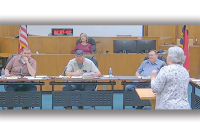
Last week, Jackson County commissioners clearly had enough — at least enough of Leatherwood’s signs. The 83-year-old, who is less than 5-feet-tall and must rely on Jackson County Transit to get to meetings, was told that she could no longer bring signs into the boardroom. She can display them outside in the hall, however.
The dispute between Leatherwood and Jackson County’s elected officials appears a simple matter of free speech rights versus political leaders’ duties to conduct public business. But the situation isn’t as clear-cut as it might seem.
Legal experts are divided on whether signs alone constitute disruptions. And then there’s the Leatherwood factor: her attacks are highly individual, even vile by most people’s standards. The accusations are at times untethered in reality. She uses an allotted three minutes of time, given to any member of the public who wishes to address the board at meetings, to abuse her chosen target’s character, personal integrity and ethics.
Leatherwood can weave a tapestry of conspiracy out of a single cat’s hair, with just about as much evidence to support her claims. She routinely exceeds her three minutes, requiring constant prodding by Commission Chairman Jack Debnam to finish talking so that others have an opportunity to speak. And under a different chairman and previous board of commissioners, Leatherwood once left the meeting room escorted by sheriff’s deputies.
About two years ago, Leatherwood began using props, holding up signs in the board room during meetings.
‘It’s a disruption’
Debnam’s decision to ban Leatherwood’s signs follow an initial decision made a few months ago to remove her from “press row,” an area reserved for county employees and members of the news media. Seated then directly behind county administrators, Leatherwood chatted distractingly to anyone nearby while business was conducted.
Leatherwood had her signs then, too. Debnam said that he hoped to hinder her ability to distract by asking that she sit in the publicly designated area.
That certainly didn’t work, he noted. Leatherwood promptly took up a new post, standing in the aisle to one side of the board room, signs in hand, in an even more prominent position than before.
“I don’t have anything personal against Mrs. Leatherwood,” Debnam said Monday. “We give her the three minutes to do what she wants to do. I don’t care if she brings an 8-by-10 signboard and props it up while she speaks, but I don’t think it’s fair to allow her to stand in front of everybody during meetings and hold up a sign. I think that’s a disruption, and that it’s uncalled for.”
State law gives elected officials the right to conduct meetings without disruptions. Backed on his legal reasoning by County Attorney Jay Coward, Debnam pulled the plug on Leatherwood’s signs. Leatherwood, predictably but perhaps not entirely inaccurately, cried foul.
“It’s a violation of free speech,” Leatherwood said, adding that she had been shocked by Debnam’s action.
Leatherwood’s signs are generally slightly larger than a desk calendar. They display points she wants emphasized and often excerpts the state’s general statutes. The content varies according to who serves as her latest target.
Violation of law?
There’s no doubt Leatherwood’s behavior is difficult, and that her accusations are hostile and, to date, mostly unfounded. But that’s not the issue, according to longtime N.C. Press Association Lawyer Amanda Martin.
Here’s the bottom line, as Martin framed it: would Leatherwood be allowed to hold her signs if she had a history of delivering verbal flowers, kisses and accolades to commissioners instead of flinging wild accusations?
“Is bringing a sign disruptive? I don’t think that simply having a sign is disruptive,” Martin said. “It could be because they don’t like it, that it’s just bugging the commissioners. And that’s not disruptive. I don’t think that’s a violation of the law.”
Debnam said in response that he doesn’t care what the signs say, whether they are in favor of him or against him or for fellow board members or against them.
“I don’t want her to hold anything up,” the Jackson County chairman said.
Leon “Chip” Killian, Haywood County’s lawyer since 1971, supported the neighboring county board’s decision to deem signs in the boardroom disruptive.
“I don’t think my board would look kindly upon someone holding up signs anymore than we would someone interrupting,” Killian said. “I think a sign is a major interference.”
But John Nowack of Sylva, who was an eyewitness to the events unfolding in Jackson County’s boardroom, said that he believed the county’s leaders fell short in understanding and compassion. And, Nowack said, of upholding the simple “human dignity” of an aging, elderly resident.
“I was surprised,” said Nowack, adding that this had been the first commission meeting he’d attended. “They really presented themselves poorly in the way they handled this.”
A difficult task
Longtime Macon County Commissioner Ronnie Beale, who previously served as chairman of that county’s board, said balancing free speech with the need to conduct business can prove a delicate undertaking.
“But that’s the privilege of being in America,” Beale said. “You don’t want people to disrupt, and there’s rules to cover that. But if they want to be a part, we welcome them in this community.”
Beale isn’t joking. During one commission meeting in Macon County, the then-board chairman had a speaker during public session flop down onto the floor, apparently making a point that escaped the reasoning of others present in the room.
“I tried to be cordial and respectful, but I said (name of flopper) ‘If you fall on that floor again, I’m going to call 911 and have you carried out of here,’” Beale recounted.
Problem solved, at least in that particular case, Beale said. After that, the flopper remained standing and spoke respectfully.
“It’s a lot how you handle things. If you are antagonistic, it’s not going to get any better,” he said.
That said, Beale heavily underscored the absolute need and right for boards to avoid disruptions by members of the public.
Sylva’s interim Town Manager Mike Morgan echoed Beale’s thoughts. He said that striking the correct balance is difficult. Many board regulars are simply grandstanding, Morgan said. He noted that when Buncombe County, which televises its meetings, opted to turn the cameras off during the public comment segment, the number of people angling to address that board plummeted.
When Haywood County was being inundated by public comment at its commissioners’ meetings two years ago — with the same line-up of speakers taking 90 minutes at the start of nearly every meeting — the county likewise contemplated taking the public comment period off the air to discourage grandstanding. Instead, the county began more strictly enforcing the three-minute time limit and quit answering questions posed by speakers at the podium, a practice that tended to lead to prolonged exchanges.
So far, Leatherwood has reserved her protests for the county, although last week she showed up at Sylva’s town board meeting with a sign in hand. The town has not taken any action to ban signs.
Morgan said that while serving as town manager of Weaverville he cautioned his former staff to listen closely to those who spoke to that town’s board, no matter how familiar and boring it might seem. Every once in a while, Morgan said, board gadflies knock the ball out of the park.
Or, in other words, the fool sometimes emerges the Shakespearean fool: wiser, that is, than the rest of us.
Tug-of-war over Cherokee sign takes a new turn
Maggie Valley has been rallying allies in its fight to save a small but perhaps precious sliver of its struggling tourism trade: pass-thru business from travelers en route to Cherokee.
A highway sign currently proclaims Maggie Valley as the proper way to reach Cherokee for tourists coming from Interstate 40. But Maggie could be stripped of this coveted status.
A new sign has been proposed that would lay-out two possible routes to Cherokee: one through Maggie Valley and one that continues through Jackson County.
The Maggie route is shorter distance-wise, but follows a narrow, two-lane winding road over Soco Gap. The route through Jackson County is longer, but sticks to a four-lane divided highway.
Maggie leaders perceive any change in the signage as a threat, potentially diverting tourist traffic away from their doorstep and into the welcoming arms of Jackson County instead.
Maggie Valley Mayor Ron Desimone said directional signs shouldn’t be hijacked as a tool to promote one town at the expense of another.
The push for new signage came from Jackson County leaders and the Eastern Band of Cherokee Indians. As a result, the N.C. Department of Transportation has been studying the issue for several weeks, comparing traffic counts, drive time, crash statistics and scouting the roadside for where a new sign could go.
While tourists’ wallets are clearly an undercurrent in the tug-of-war over the Cherokee sign, DOT maintains that won’t influence its decision.
“Economic development is not going to be a factor,” said Cece Hipps, president of the Haywood County Chamber of Commerce. “It doesn’t carry any weight to say it would hurt economic development in our county if they changed the route. Their number one is safety.”
As a result both sides have resorted to arguing their route is the safest or most direct.
But clearly that is not what drove Jackson County to try to wrest the Cherokee sign away from Maggie Valley in the first place, Maggie Valley Town Manager Tim Barth said.
“They said it has nothing to do with business, but it has everything to do with business,” Barth said.
“I’m sure their motive is the same as ours,” agreed Ron Leatherwood, chairman of the Haywood County Chamber of Commerce.
Much ado about nothing
Just how much Maggie stands to lose if the sign is changed is anyone’s guess, but to the struggling mom-and-pop motels and diners lining Maggie’s main drag, losing even one room night or one table is one too much in this economy.
Thus, Maggie pledged earlier this month not to give up without a fight, and since then has sprung into action.
A meeting of key players in Haywood County’s business and tourism sectors, along with town leaders from Waynesville and Maggie, held a strategy meeting Monday to craft their own lobbying campaign.
The attention the debate has garnered had some in the room scratching their head over how much difference it will really make.
“I don’t think anyone is going to see a blip in their business one way or the other,” Leatherwood said. “I see it as much ado about nothing. But there are 10 of us in here having a meeting about it so it must be something.”
Waynesville Mayor Gavin Brown also questioned whether directional signs really influence the route travelers take.
“If you want to go to Cherokee, you already know how you are going to Cherokee,” Brown said.
Waynesville was put in the middle of the debate early on. Technically, Waynesville stands to gain by a new sign. Right now, Cherokee-bound travelers who take the Maggie highway exit never make it to Waynesville’s doorstep. Jackson County leaders assumed that Waynesville would like the idea of a new sign, encouraging Cherokee visitors to instead stay on the highway and giving Waynesville a shot at capturing some of the traffic.
But Waynesville, it appears, has put its allegiance with Maggie Valley as a fellow Haywood County town first. Rather than join sides with Jackson, Waynesville has sided with Maggie Valley.
Brown isn’t sure how much tourism business Waynesville would really pick up from pass-thru traffic heading for Cherokee, except for gas stations right near the highway exits.
“I think the gain for Waynesville would minimal, but it could hurt Maggie,” Brown said. “I am not going to stick them when they’ve got problems.”
While it’s easy to ascribe an ulterior motive to Jackson County’s posturing, Haywood’s leaders were puzzled why the tribe has weighed in.
“That’s what I want to know — what’s it in for them?” DeSimone asked.
While U.S. 19 slides undramatically into the backside of the reservation with little in the way of an official welcome, Cherokee sees U.S. 441 as more of a bona fide gateway to the reservation, passing by the doorstep of its signature golf course and bringing tourists in closer proximity to the heart of downtown Cherokee — before eventually arriving face to face with the towering casino entrance. For tourists who come over Soco Gap on U.S. 19, their first view of the casino is its parking deck.
Both the tribe and Harrah’s direct travelers to come in on U.S. 441 — and specifically advise travelers not to take U.S. 19 — in their tourism literature and web sites.
“They are already doing everything they can to drive traffic that route,” Hipps said referring to U.S. 441.
Only about 3,500 vehicles a day on average make the climb over Soco Gap, but it fluctuates widely given the seasonal nature of tourism in Maggie and Cherokee.
“That number can be pretty high in the summer and pretty low in the winter,” said Reuben Moore, technical services engineer for the DOT regional office in Sylva.
Meanwhile, about 15,000 vehicles a day frequent U.S. 441 near the Cherokee exit.
A new sign
The cost of a new sign would be about $100,000 minimum — and perhaps double that depending on how much information it attempts to convey about the two dueling routes.
It’s unclear whether those requesting the new sign could be made to pay for some portion of it.
Maggie leaders expressed frustration that DOT is trying to fix what ain’t broke, but N.C. Rep. Ray Rapp, D-Mars Hill, pointed out that this landed in DOT’s lap.
“DOT didn’t invite this. They don’t want it,” said Rapp, who represents Haywood County in Raleigh. Jackson County and the tribe forced the issue with their requests to DOT.
“They have a responsibility to respond to that. They can’t just blow it off,” Rapp said. “I think they are trying to find a compromise that will satisfy everyone.”
But Moore, the DOT’s staffer who came up with the alternative sign, doesn’t like to call it a compromise. That would imply DOT’s goal is to satisfy the whims and wishes of dueling tourism interests.
Rather, DOT is merely acknowledging that there are in fact two ways to Cherokee.
“I hesitate to even call it a compromise, so much as from my point of view a position that correctly communicates the travel options,” Moore said.
The new sign would list each route followed by driving distances: 35 miles through Jackson County and 24 miles through Maggie.
But the sign wouldn’t stop there. A series of footnotes and disclaimers would caution drivers that U.S. 19 through Maggie has “six miles of steep winding road” and is “not recommended for large vehicles.”
There’s plenty of additional factors drivers might like to consider, however. Elderly drivers whose hand-eye coordination and reaction time isn’t as keen as it once was might prefer sticking to the four-lane highway. For any cell-phone addicted drivers out there, it’s worth noting the route over Soco Gap has a whopping three-mile dead zone with no reception. But if you’re craving boiled peanuts or in the market for pottery, the roadside stands of Soco are a must.
But alas, when it comes to additional footnotes, there just isn’t room on the sign as it is. Besides, the DOT won’t get into judgment calls like this and instead is sticking to the empirical data — which route is most direct and which is safest.
U.S. 19 through Maggie wins for being the most direct route, hands down.
“It is a beeline. A curvy, windy beeline maybe, but it is the shortest distance,” Moore said.
So which route is safer? The crash rate — which in simple terms is the ratio of wrecks to the total number of vehicles — is 10 percent higher for the Maggie route.
But Desimone said the crash rate difference is negligible.
“We are really splitting hairs here to get to the safest route,” Desimone said. “There is no compelling reason to change that sign.”
However, the Eastern Band of Cherokee Indians continues to express concerns about wrecks on the narrow, two-lane mountain road, Moore said, especially when it comes to large vehicles, like campers, RVs and motorcoaches.
Moore said he plans to study a breakdown of wrecks in more detail, particularly the large-vehicles that seem to be a source of greater concern.
While each side in the case clamors to pull off the best lobbying campaign, Moore said that won’t factor into their decision, nor will who carries the most political weight.
“Absolutely not,” Moore said of directional signs. “That is a DOT responsibility.”
The great Cherokee sign debate
Haywood and Jackson counties are butting heads over the privilege of being the preferred route to Cherokee — a tagline that carries with it a shot at enticing Cherokee-bound travelers to drop a little change on their way by.
With 3.5 million visitors a year, Harrah’s Cherokee Casino and Resort is the largest single tourist attraction in the state. Couple that with hundreds of thousands of additional tourists coming to Cherokee as a cultural destination or jumping off point for the Great Smoky Mountains National Park — and it’s easy to see why neighboring communities would be fighting over what at first glance seems like little more than crumbs. All those crumbs can add up.
Turn-about is fair play
No longer resigned to playing defense, Haywood County’s leaders decided to mount their own push for a second sign to Cherokee — one that would be placed in Jackson County letting tourists know they can get to Cherokee by coming through Waynesville and Maggie.
To cater to travelers from the Atlanta region, Haywood wants a highway sign on U.S. 441 near Dillsboro letting travelers know they can get to Cherokee by coming up and around through Haywood County — even if it is a far more circuitous route.
Ron Leatherwood, chairman of the Haywood County Chamber of Commerce said if Jackson is asking for a second sign in Haywood, Haywood can ask for a second sign in Jackson.
“We should ask DOT to do the same study. If they are doing it for one, they should do it for us,” Leatherwood said.
The DOT will soon be getting formal letters signed by the county tourism board, the Haywood County Chamber, the Maggie Chamber, the towns of Maggie and Waynesville, the county’s economic development commission and perhaps the county commissioners asking the route through Maggie remain on directional signs for Cherokee. They hope their letters will counter the letters DOT has already received from Jackson County and the tribe.
Merger of Jackson County tourism entities on the table
While a proposed room-tax hike in Jackson County has been sidelined at least for now, the idea of merging the county’s two tourism entities has been tapped for further study.
Jackson County commissioners plan to appoint a task force to study forming a single tourism agency for the county. Currently, Cashiers has its own tourism agency in addition to the countywide tourism agency based in Sylva. Each are affiliated with the chambers of commerce offices, too — one based in Cashiers and one in Sylva.
There are simply too many players involved in county tourism efforts, to hear Commission Chairman Jack Debnam tell it. He says that a single entity would be more effective and reduce costly and unnecessary duplication.
“I do believe in one (tourism authority) myself, and maybe some advisory boards,” Debnam reiterated to fellow commissioners last week. “I’d like to see us finally act like we are one county. With the people coming off the board, it’s the time to look at restructuring.”
Recent news that the long-time director of the Cashiers chamber and tourism agency, Sue Bumgarner, would retire could make such a restructuring easier. Bumgarner’s retirement will be effective in July and comes following of heightened scrutiny on how Cashiers was spending its cut of the tourism funding pie.
“It seems like an opportune time if we do want to make changes,” County Manager Chuck Wooten said.
In addition to Bumgarner’s retirement, there are four vacancies coming up on the Jackson County tourism board and two vacancies on the Cashiers tourism board, Wooten said.
Cashiers TTA board member Mike Henry said the board doesn’t know yet whether it will hire a replacement for Bumgarner or wait to see what the task force recommends about a merger.
“We haven’t met yet to form a plan,” he said.
While commissioners haven’t yet appointed task force members, Debnam recommended Julie Spiro, head of the Jackson County Chamber of Commerce, and Commissioner Mark Jones, who doubles as chairman of the Cashiers TTA; along with himself.
Jones enthusiastically endorsed Debnam’s olive-branch proposal. Jones constituents in the Cashiers area haven’t been happy about the proposed merger of the Cashiers agency into a single countywide one.
Room tax hike sidelined
Meanwhile, Debnam squelched the recent push for a room tax hike from 3 percent to 6 percent, however, saying it had been ill-considered.
“I would like to continue to spend some more time on this, to learn more about the impact we may have and exactly how we want to structure this,” Debnam said. “We made an error; we moved a little too fast, we were not informed enough to make the decision we tried to make.”
Debnam and his fellow commissioners faced a phalanx of outraged lodging owners in Jackson County when they passed, 4-1 with Jones voting no, to increase the tax. Commissioners subsequently rescinded that vote because they failed to hold a required public hearing.
Regardless of mistakes made and future plans to be made, finding the correct answers are critical to Jackson County’s economic wellbeing, Commissioner Doug Cody said.
“The decision was made years ago … to hang Jackson County’s economic health on travel and tourism — kind of deemphasizing” other forms of economic development, he said. “If we’re going to hang our hat on tourism, we’re going to have to get out and fight for those tourism dollars. We’ve got to make Jackson County a destination for people, not a pass through for other counties.”
Wooten said that commissioners would need to make their appointments promptly to the tourism committee to enable it to report back to them sometime this summer.
Jackson reval probably will occur in 2016; commissioners cite lack of sales data for second postponement
Jackson leaders will likely pushback a countywide property revaluation from next year to 2016 following a strong recommendation by their tax man.
“Truthfully, if you want this thing done and you want it done right, we don’t have an adequate timeline,” Tax Assessor Bobby McMahan told commissioners last week. “The more time we have, the better quality our work is going to be.”
Commissioners had instructed McMahan and his staff to move forward with a revaluation in 2013, which was already one year later than originally planned.
In a revaluation, every home, lot and tract of land is assigned a new property value to reflect the going real estate market — a value that in turn dictates how much people pay in property taxes.
Several residents made a public appeal to commissioners earlier this month to delay the revaluation beyond 2013. Falling real estate prices for high-end homes means affluent property owners will see their taxes come down in a revaluation, and the burden would be redistributed to the county’s middle-class residents.
Most of the property tax burden is currently shouldered by property owners in Cashiers-Glenville area, dominated by high-end resorts and second- and third-homes. Delaying the revaluation means the county could continue could taxing these high-end properties at an inflated book value.
But that isn’t the reason the county is giving for the delay. McMahan said there simply is a lack of sales data — not enough homes and lots being bought and sold — for the county to know what the going rate is for property.
The drop in sales is staggering: there are 444 sales from the past three years that could be considered for the revaluation, noted Commissioner Mark Jones who is from the Cashiers-Glenville area. That, McMahan added, compares to nearly 8,000 property transactions during the last revaluation period.
“It just makes our position of trying to proceed less defensible,” Chairman Jack Debnam, a real estate agent in real life, said of the woeful sales numbers.
The lack of sales makes it difficult to set accurate values that Jackson County could defend in potentially costly legal appeals. Property owners who disagree with a county’s revaluation have the legal right to challenge on a state level. Counties must be able to prove how they arrived at property values by using data from actual sales.
“Would you say the big driver is the lack of sales?” Commissioner Doug Cody asked in reiteration of the shifting county position about when exactly to conduct a revaluation.
“That data is the most important thing you have to have,” McMahan said in reply.
“If postponed, what portion of your work would be in vain? How much of that would still be used?” Commissioner Charles Elders asked McMahan.
“None of it is in vain,” the tax assessor said in response. “You never truly quit, never totally stop working on revaluation.”
“And to do the job you should do, you really need this (extra) time,” Elders said. “You don’t need guess work?”
“Right, you don’t need to guess,” McMahan said in reply.
Tax Assessor Richard Lightner in neighboring Macon County successfully encouraged commissioners there to delay until 2015, the legal eight-year span allowable since the county’s last revaluation in 2007. He, too, cited likely indefensible legal action in his recommendation.
Haywood County, unlike counties farther to the west, moved forward with a revaluation last year after postponing it by just one year. Property values on a whole remained flat, although there was variation between types of property and neighborhood. Haywood does not have nearly the same volume of high-end second homes, however.
Swain County did a revaluation two years ago but tossed the results out. It will conduct a revaluation in 2014.
Commissioners angle for piece of library glory in plaque dispute
Jackson County leaders have decided that tradition is overrated.
Six months after the new Jackson County library opened, commissioners have decided whose name to put on a plaque in the foyer — a spot that until now featured a cardboard placeholder.
The verdict?
The names of two different boards of commissioners will be listed on the commemorative plaque for the new library, not just the board of commissioners who took the political heat when it was built.
“Can we talk about the plagues?” Chairman Jack Debnam asked fellow board members during a daylong retreat last week, a reference to a typo on the agenda sheet that was supposed to read, “library plaques.”
County Manager Chuck Wooten added, also amused by the typo, “I have not taken any steps to order those plaques. And I just need some direction, and it will be a plague I can eliminate from my agenda.”
The tempest in a teacup first burbled to public notice last summer, when Jackson County in June celebrated the opening of its $8 million public library in Sylva, a project that included renovations to the historic courthouse.
Before new commissioners and a new county manager took office last fall, former County Manager Ken Westmoreland had submitted the design for a plaque with a typical inscription used on new-building plaques in Jackson County. The plaque was to list the names of the political leaders who were responsible for funding the library; the county manager’s name leading the effort; and the names of the architect and general contractor involved.
When three new commissioners took office, that plaque design was placed on hold.
Wooten told commissioners that on his own initiative he decided that giving sole credit to the former commissioners wasn’t fitting. The new commissioners were making a substantial investment in the new library by increasing its annual operating budget. Wooten felt the three new board members should be included, too. But Wooten decided not to include the name of the previous county manager’s name, or his as the current county manager. He did opt to keep the architect and general contractor.
“At that point in time, I said, ‘Well, maybe we should take a different approach to it,’” Wooten said in explanation.
Debnam, in typical fashion told fellow board members that he’d rather take yet a different approach, an even more radical one than that being offered by the county’s manager — Debnam questioned whether any commissioners at all should attempt to claim plaque acclaim.
“Well, I for one have an issue with self gratification,” Debnam said, adding that county buildings are “built by and for the people of Jackson County.”
“What did we do?” Debnam said as he expounded on his individual theory of plaque appropriateness. “It’s not our money we’re spending. I know there seems to be a history of doing this — somewhere it started, somewhere it needs to end.”
It didn’t end this time, though. Commissioner Joe Cowan, who in fact voted against building the new public library at the site of old historic courthouse, agreed that both boards should be included on the plaque. Cowan did not touch on his opposition to where the new library was sited, even though he has gone on record recently reminding people that he had been against the site when predictions of a parking shortage on courthouse hill came true.
But that was then, and before Jackson County residents posted record numbers in library attendance and the facility won a statewide award for general loveliness and excellence.
A plaque, Cowan said as he expounded on his own theory of plaque appropriateness, “identifies who was around, and maybe who had the guts to stand up and build the building, by golly — that you are willing to stand up and put your neck and maybe your next election on the line.”
Cowan said that he believed there’s no shame in credit being given where credit was due.
“I don’t have a problem whatsoever with both boards being on there. In some ways, it’s more reflective of what has happened,” Cowan said in summation, still minus mention that he opposed the new library being built as an add-on to Jackson County’s historic courthouse.
The plaque will cost between $1,100 and $1,900, based on whether it is aluminum or brass, Wooten said, after receiving enough of a consensus from the board to combat this ongoing plague.
The road less traveled
The question ‘which way to Cherokee?’ continues bedeviling the state transportation department, which has been caught in a tug-of-war between Jackson County and Maggie Valley over who deserves a sign pointing the “right” way to Cherokee.
Maggie Valley currently holds title to the sole directional sign pointing motorists to Cherokee via U.S. 19 and over Soco Gap — and would like to keep it that way.
“We are all for helping promote Jackson County, but not at the expense of Maggie Valley,” said Maggie Valley Mayor Ron DeSimone.
The N.C. Department of Transportation is “leaning toward” posting a sign indicating that there are in fact two routes to Cherokee — one through Maggie and one that continues on past Sylva.
But by posting another sign, the department of transportation would “take away from one and give to another,” said Alderman Mike Matthews. “There has not been enough information to say you should go this way versus this way.”
Jackson County officials, meanwhile, have lobbied for the second sign, pointing out that the four-lane highway going past Sylva is actually safer and more user friendly than the route through Maggie. The tribe has expressed a desire for a second sign.
“They feel like the two-lane road over Soco is hazardous,” said Reuben Moore, a DOT official who works in the regional office in Sylva.
But DeSimone questioned Jackson’s true motive.
“Obviously, Jackson County did not bring this up because they were concerned for public welfare,” DeSimone said.
Maggie Valley could win out, however, as the DOT has yet to find a place to put the new sign and has not settled on concise wording.
Safety and travel time
Moore updated the Maggie Valley Board of Aldermen on the status of the sign issue at a town meeting last week.
If the DOT decides to allow a new sign, it would be placed by May before the beginning of the tourist season.
But, posting a new sign faces several obstacles, including where to place it.
“It takes about a mile of signage to properly sign an exit,” Moore said. But the roadside leading up to the Maggie exit is already cluttered with signage.
DOT has not settled on the appearance of the sign. It cannot simply put two dueling arrows on a sign pointing this way or that way to Cherokee.
“That is strictly against policy,” Moore said.
The DOT has discussed making a sign with the words Cherokee spanning the top half of the sign and the mileage for both routes below it: U.S. 74 at 37 miles and U.S. 19 at 24 miles.
Although the route through Maggie is shorter distance-wise, a study by the DOT showed that travel time was essentially the same — about 35 minutes — no matter which road was taken.
“We found that the travel time was very nearly the same,” Moore said.
Initially, Moore wanted the sign to specify that the travel time was about the same no matter which route is taken, but DOT vetoed the idea because traffic or accidents could delay travel along one of the roads.
The department only test-drove the routes three times during the late fall and winter. The times do not account for increased traffic during the summer and early fall months when tourists flood the area. Get stuck behind a slow moving Winnebago, and the trip through Soco Gap could be a grueling one.
The review of both routes showed that the crash rate on U.S. 19 is 10 percent higher.
Alderman Mike Matthews said that the two roads are incomparable when it comes to wrecks because U.S. 19 runs through a town where cars are often slowing down or speeding up and pulling in or out of parking lots. The U.S. 441 route, however, is a four-lane divided highway.
“I don’t even see how that could be compared,” Matthews said.
Maggie Valley officials said they want “overwhelming, definitive information” showing that the road through Jackson County is safer.
Does DOT consider U.S. 19 to be safe, Matthews asked?
“Absolutely,” Moore responded.
Aldermen Saralyn Price asked Moore pointblank which road would he take if it was snowing and he was in Lake Junaluska.
“I wouldn’t be out,” Moore said.
The Board of Aldermen argued that the DOT has not provided any information that would validate a decision to post a new directional sign.
“I have not heard anything definite about (U.S. 441) being safer,” DeSimone said.
Capturing tourism dollars
Maggie Valley and Jackson County each hope to attract a portion of the 3.5 million people who visit the casino in Cherokee each year.
The idea that Maggie Valley will lose business should an alternative route be posted “presupposes that people are going to do what the signs tell them to do,” Moore said.
Jackson County commissioners haven’t been shy about their desires to funnel tourism traffic through that county. Jackson County Manager Chuck Wooten and the five county commissioners expressed surprise last week that their request for a sign had triggered uproars in Maggie Valley.
As they hammered out possible designs for a new welcome sign at the county line, Commissioner Doug Cody joked that they should add to Jackson County’s fantasy sign: “This is the best route to Cherokee.”
A decision will be made based on safety and the speed of traffic, assured Moore, not based on which route is more scenic or needs more business.
According to Jackson County Travel and Tourism, visitors have said that they prefer to take U.S. 441 to Cherokee. But, Moore said he can’t confirm whether that is true.
Continue milking high-end homes for property taxes or realign real estate values?
Jackson County commissioners plan this week to discuss the upcoming property revaluation, though it remains unclear whether they will postpone the process as some residents are requesting.
In a revaluation, every home, lot and tract of land is assigned a new property value to reflect the going real estate market — a value that in turn dictates how much people pay in property taxes. But, the volatile real estate market has led many counties to postpone revaluations.
Jackson County has postponed its revaluation until 2013, but Tax Assessor Bobby McMahan has suggested waiting a couple more years. McMahan plans to give a report on the issue during a commissioner work session Jan. 13.
The market value of high-priced lots and homes are destined to fall in a countywide revaluation. Delaying the reval means the county can continue taxing high-end properties at inflated book value. Going ahead with the reval would shift property tax burden to median-priced properties as those are more likely to hold their value while the high-end properties fall — and that’s what Jackson County residents are protesting.
“You will be negatively impacting the lower-income families,” said Avram Friedman, an environmental advocate in Sylva.
Allen Lomax, a local real estate agent, told Jackson County commissioners a property revaluation “will definitely” have the most wallop on the wallets of the less affluent in the county.
While Macon and Swain have postponed their revaluations for a couple more years, Haywood County went ahead with its last year.
Counties must do a revaluation every eight years, which wouldn’t be until 2016 for Jackson.
Carol Odom of the Glenville community views the situation from another angle. She told commissioners that she’s neither rich nor under-taxed. Odom said she’s seen 75 percent of her income evaporate because of the dour economy. She believes homeowners shouldn’t be paying taxes based on false property values but that the whole county should “share their pain.”
“I hope you do revaluate, and that it gets shared all across the county — everyone should contribute. I’m not here to support other people financially,” Odom said.