Primary Election results shake up Western North Carolina
A turbulent primary season has already reshaped Western North Carolina’s political landscape, toppling incumbents, elevating new contenders and setting the stage for a consequential General Election.
Across the region, voters delivered decisive verdicts in races for Congress, the General Assembly and key county offices, while several high-profile contests reflected deeper tensions over taxes, disaster recovery and divisive social issues.
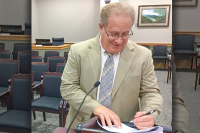
Rogers upsets Pless in NC House primary
Two counties hit hard by Hurricane Helene in Western North Carolina will soon have a new representative in the General Assembly, after Republican Primary Election voters backed a challenger who won by nearly 10 points.
Haywood and Madison counties comprise the 118th House District and together tallied more than $200 million in losses from the Sept. 27, 2024, storm, which caused $60 billion in damage statewide.
Western North Carolina voters look to move forward
Western North Carolina voters turned out in strong numbers across municipal races this year, deciding contests that will shape local recovery, infrastructure and growth for years to come.
In Haywood, Jackson, Macon and Swain counties, ballots featured a mix of incumbents and newcomers in competitive races that reflected both the challenges and the momentum of a region still rebuilding from repeated disasters — a region where voters think they’ve now chosen the right people to move it forward.
EBCI Sept. 4 tribal council general election unofficial results
The Eastern Band of Cherokee Indians on Sept. 4 held its general election for tribal council. Twelve tribal members — two from each community — are elected to tribal council every two years. Turnout hovered at about 30% of eligible voters. Four women were elected to the board, a historic marker.
WNC outdoors recreation survey highlights economic impact of industry
The MADE X MTNS Partnership released the results of the Western North Carolina Outdoor Recreation Participation Survey, conducted in partnership with the Center for Economic Research & Policy Analysis at Appalachian State University and the Institute of Tourism and Recreation Research at the University of Montana, to establish a foundational dataset supporting the economic impact of outdoor recreation participation in the region.